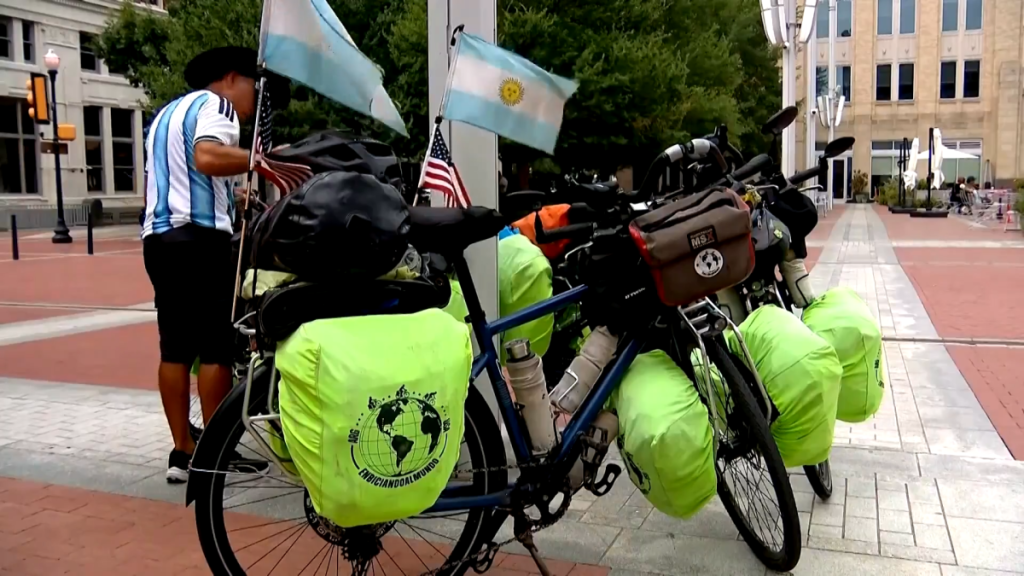
Three longtime friends from Argentina—Vicente Conculini, Miguel Silio and Shamandu Martinez—are riding bicycles across continents on a quest to arrive in the United States for the 2026 FIFA World Cup, and they stopped briefly in Fort Worth, Texas, as part of the trip that has already taken them through 17 countries and roughly 10,000 miles.
The trio set out to follow their passion for Argentina and soccer, documenting every stretch of the road on social media where tens of thousands now follow their progress. Their online presence has turned a private adventure into something public and communal, with followers checking in on weather setbacks, border crossings and celebratory moments. That following also provides encouragement when the miles feel long and the routes get complicated.
Arriving in Fort Worth was a small cultural punctuation on a very long route, and the friends marked the moment the way travelers do: they bought cowboy hats and posed for photos. Those hats were a lighthearted snapshot of how travel folds local colors into a journey that began in Argentina and spans continents. For a few hours, the wide Texas sky replaced the Andes or Central American coastlines on their mental map.
Traveling light is part strategy, part necessity; their bikes carry small, brightly colored bags and Argentina flags that act as both luggage and calling card. The flags announce who they are before they even speak, and the compact packs let them move quickly when road conditions demand it. That minimalism has meant learning to improvise when weather turns ugly or roads become impassable.
Those weather challenges have forced them off pedals and onto other modes of travel more than once, with sections of the trip completed by train or even horseback when the terrain insisted. Such detours remind them that the trip is not strictly a straight line from point A to point B, but a sequence of adaptable plans and local solutions. Each adjustment becomes part of the story they share with followers and strangers alike.
When they first announced the ride, many people thought the plan was a little crazy, but skepticism has given way to curiosity and hospitality along the route. Strangers stop them to ask about maps, motives and the story behind the flags, and those conversations often lengthen into unexpected friendships. The trio traded steady day jobs for this open-ended adventure and now rely on the kindness they find along the way to keep momentum and morale high.
Miguel says the people they meet are the true highlight, and that the trip has left their hearts full in ways no itinerary could predict. Sharing mate, the traditional South American drink, has become a ritual for them and a bridge when cultures meet on dusty plazas or busy border crossings. Passing mate around opens doors; it prompts conversations and invites strangers into a small circle of fellowship wherever the road allows.
One member of the group is married with children, and his family has been part of the journey in a tangible way: his wife made four visits during the trip, and the couple’s family plans to attend World Cup matches in the United States together. That family involvement frames the ride as more than a youth dare or a solo endurance challenge; it is a shared project that threads together relationships across continents. They also say they plan to return to North Texas when Argentina plays in the region, folding the Fort Worth stop into a larger map of future celebrations.
As the cyclists push onward toward what they call Team Argentina’s home base ahead of the World Cup, their story carries a practical streak alongside sentiment: they document routes, gear choices and border experiences for followers and for themselves. The blend of grit, improvisation and ritual makes their journey less about an end date and more about a series of earned days on the road. Photo updates, short videos and candid reflections keep followers invested as the trio continues toward the stadiums of 2026.
“This story was originally reported for broadcast by NBC DFW. AI tools helped convert the story into a digital article, and an NBC DFW journalist edited it again before publication.”