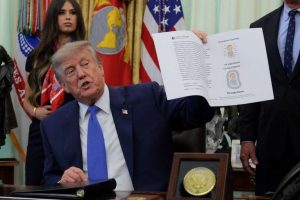
President Donald Trump will unveil a new package of economic measures against the Islamic Republic of Iran at a news conference on Monday. Treasury Secretary Scott Bessent described the steps as “the toughest sanctions in history,” adding that they are intended to pressure Tehran while the United States and its allies continue military operations in the region.
What the sanctions target
The upcoming restrictions focus on Iran’s ability to move oil and generate foreign revenue. Officials say the United States will aim at major Chinese buyers of Iranian oil, independent refineries, and banks that process Iranian payments. The Treasury also plans to expand actions against tanker managers, insurers, ports, and ship‑to‑ship transfer providers that facilitate the shadow fleet Iran uses to evade existing rules.
Impact on ordinary Iranians
Experts warn that the new measures will likely hit everyday Iranians hardest. Energy strategist Umud Shokri, a senior visiting fellow at George Mason University, explained that tighter sanctions could weaken the rial, drive inflation higher, raise the cost of imported goods and industrial inputs, and reduce household purchasing power. Wage earners, pensioners, small‑business owners and lower‑income families are expected to feel the greatest strain.
Recent footage from Tehran and Karaj shows empty market stalls and vendors struggling to sell fresh produce. Residents reported that essential items such as certain medications, foreign‑made shampoo, conditioner and toothpaste have become scarce or prohibitively expensive. One Tehran resident, Nima, a 36‑year‑old, said many “important things we need we can’t even get.” Another Tehran resident, Neda, who suffers from kidney disease, said she can only afford half of her prescribed medication each month.
Iran’s evasion network
For decades Iran has built a sophisticated web of front companies, brokers, exchange houses and a shadow tanker fleet that uses ship‑to‑ship transfers, altered tracking data and false documentation to move oil outside the traditional banking system. In 2024, U.S. financial‑crime regulators reported about $9 billion of Iranian shadow‑banking activity flowing through U.S. correspondent accounts. Shell companies in the United Arab Emirates, Hong Kong and Singapore facilitate billions of dollars in transactions, often paid in Chinese yuan or through barter arrangements.
Political backdrop
The sanctions come amid a deadlock in diplomatic talks aimed at ending the six‑month conflict that has seen Iran disrupt shipping through the Strait of Hormuz. Trump has warned other nations that providing any “lifeline” to Iran could bring “tremendous economic consequences.” Critics note that the timing may also reflect domestic pressure from U.S. consumers concerned about rising gas prices ahead of the midterm elections.
Potential challenges
Targeting Iran’s revenue streams will require coordination with allies, particularly China, which could retaliate against U.S. interests. Experts say that while the sanctions may curtail Iran’s ability to fund its military and proxy forces, the regime’s entrenched network of politically connected institutions is likely to remain partially insulated, continuing to profit from smuggling, currency manipulation and control of scarce imports.
For now, ordinary Iranians face a worsening economic outlook, while the United States prepares to apply additional pressure in hopes of compelling Tehran to alter its regional behavior.
Original reporting: El Paso News (HLL/CB) — read the source article.