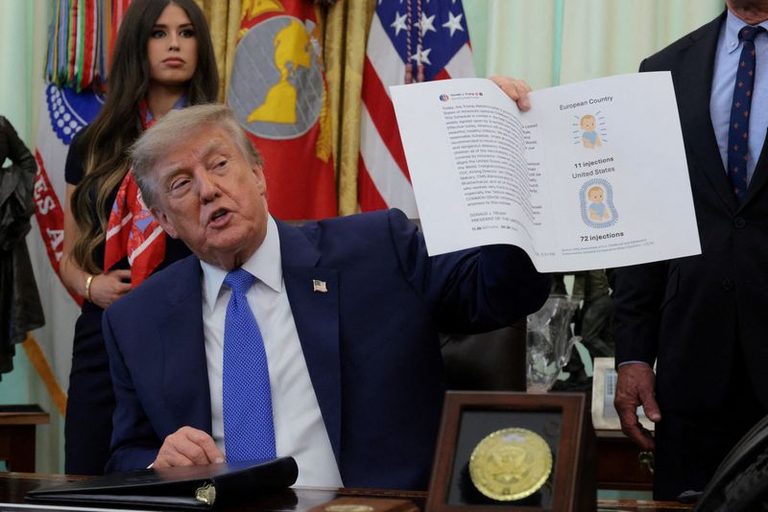
Washington – President Donald Trump, citing parental concerns about a possible link between vaccines and autism, signed an executive order this month that would trim the federal childhood immunization schedule from 17 to 11 shots. The order also calls for separating the measles‑mumps‑rubella (MMR) vaccine into three separate injections and directs the Justice Department to challenge state requirements that children receive vaccines to attend school.
Federal officials say the order is limited
Five current and former officials familiar with the process told Reuters the order does not substantially alter U.S. vaccine policy and is unlikely to satisfy either Trump or Health Secretary Robert F. Kennedy Jr.’s “Make America Healthy Again” base. They noted that the Justice Department’s challenge to state school‑entry mandates will face legal hurdles, and that separating the MMR vaccine could take years for manufacturers to implement.
Health Secretary’s ongoing studies
Kennedy and his allies have launched a series of studies examining alleged dangers of vaccines, including potential connections to autism, autoimmune disease, and immune‑system changes. The Department of Health and Human Services confirmed it is pursuing dozens of analyses using large national health datasets. Critics argue the studies risk misinterpretation and may be driven toward a predetermined conclusion that vaccines are more harmful than the diseases they prevent.
Medical community warns of increased confusion
Leading medical groups warned that the order could heighten vaccine hesitancy among families and expose children to preventable illnesses. They emphasized that extensive research over decades has found no credible link between vaccines and autism. Del Bigtree, CEO of the Informed Consent Action Network and longtime ally of Kennedy, said the order is only the beginning of a process he believes is needed.
Legal backdrop
In January, Kennedy unveiled a reduced immunization schedule that bypassed the usual regulatory process. A federal judge blocked those changes in March, ruling that health regulators acted unlawfully. The administration is appealing the decision, but the ruling remains in effect.
Trump’s personal involvement
According to senior officials, Trump has repeatedly pressed Kennedy for progress on autism research, even holding a televised cabinet meeting at Camp David on July 31 where he asked, “How are you doing on the autism research?” Kennedy responded that an answer would be forthcoming. The president’s advisers had previously urged Kennedy not to discuss vaccines publicly before the November midterm elections, a request he reportedly honored.
Potential impact on families
The order’s reduction of the vaccine schedule could affect parental decisions and school enrollment requirements across the country. While the administration frames the move as responding to “countless parents” whose concerns have been ignored, experts caution that altering a schedule without solid scientific backing may undermine public‑health gains achieved over generations.
Next steps
Both the White House and the Department of Health and Human Services declined to comment on the specifics of the order. The Justice Department’s challenge to state vaccine mandates is expected to proceed through the courts, and the ongoing federal studies may take months or longer to produce results. Meanwhile, parents, schools, and health providers will watch closely as the policy debate unfolds.
Original reporting: Appleton, WI News Feed (HLL/CB) — read the source article.