Polly Cleveland of New York City turned to medicinal maggots while caring for her late husband, Tom, and found an unlikely tool that cleaned severe sores when conventional care stalled. Dr. Ronald Sherman, a modern maggot therapy pioneer now at Cuprina, supplies lab-reared larvae to clinicians, while practitioners like Lisa Baxter at Tufts Medical Center in Boston and Dr. David Armstrong at USC have used them for patients who could not tolerate surgery. Skeptics such as Dr. Sameer Patel in Philadelphia point to limited data and insurance hurdles, and patients like Larry Way of Malden, Massachusetts, say the results can be life-saving.
When Tom returned from the hospital he had a nasty sore on his left heel and later developed a bedsore on his buttocks. “After a stay in the hospital, he came back with this terrible sore on his left heel,” Cleveland said. “These kinds of wounds really smell foul.”
Cleveland, who has loved insects her whole life, tracked down a lab founded by Dr. Ronald Sherman and ordered a shipment overnight because hospital staff had never heard of the treatment. Medicinal maggots are considered FDA-cleared medical devices, which are specially raised in laboratories to be germ-free. Maggots are the larvae of flies.
She described the first application plainly: “You get this little vial with these teeny, tiny little maggots on a piece of gauze,” Cleveland said, noting they can also come in a sachet so they don’t wander. “I stuck the maggots in, and by golly, they did their thing.” The change was immediate enough to surprise caregivers who had watched other therapies fail.
The appeal of maggot therapy is brutal and brilliant: dead, infected tissue is food to the larvae and removing that tissue prevents deeper infection. “The maggots remove dead tissue by dissolving it,” said Sherman. “They do not have teeth. They do not bite pieces from the tissue. They secrete their digestive enzymes which dissolve the dead infected tissue in the wound, and so only that tissue melts away. The healthy tissue stays behind.”
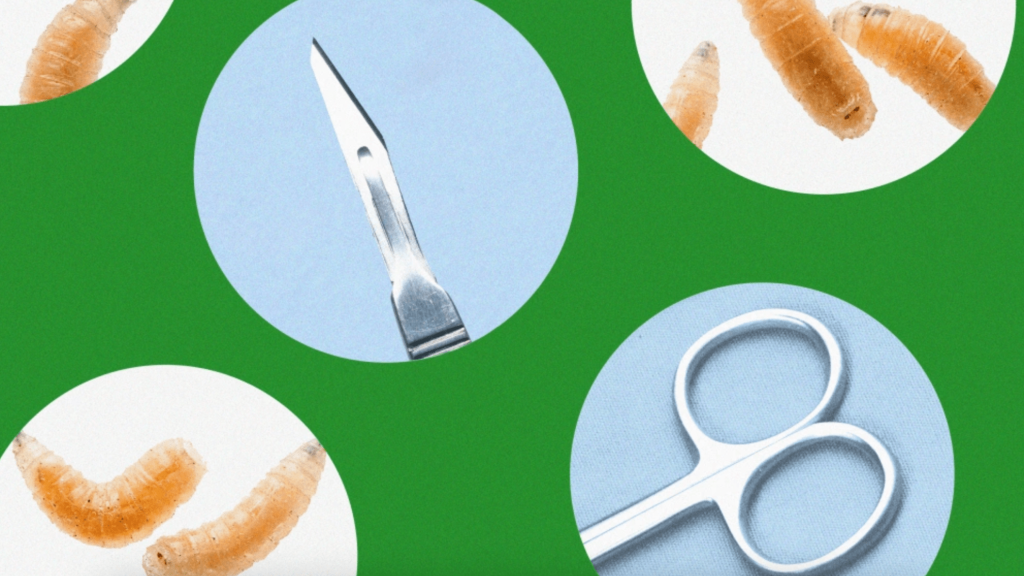
Surgical debridement remains an option, but it’s blunt compared with what maggots can do at a microscopic border between living and dead tissue. “Surgery tends to be a bit coarse,” Sherman said. “The scalpel is straight, and the border between healthy tissue and dead tissue is not straight. The surgeon’s vision is limited to a macroscopic level, not a cellular level, not a microscopic level.” That precision can spare patients further loss of tissue and reduce the need for risky anesthesia.
<p“You don’t need anesthesia, which is the greatest risk for people who are deemed poor surgical candidates,” Sherman added, which explains why teams call on maggots for frail patients. Lisa Baxter said the inpatient wound and ostomy care team at Tufts uses maggot therapy sparingly, usually for complex cases where surgery isn’t an option. “We’ve had a couple patients awaiting heart transplant that had wounds that needed to be healed before they could get their transplant, so this is sort of a simple way to expedite the process,” Baxter said.
Baxter also cautioned that maggots are not a universal fix because they dislike certain bacteria that commonly infect wounds. If the wound hosts Pseudomonas, maggot therapy won’t be appropriate, she warned. “We have to make sure that the wound does not have Pseudomonas in it,” she said.
Dr. David Armstrong leaned on maggot therapy during the Covid pandemic when a patient’s surgery for a gangrenous foot was canceled. The man had heart failure, diabetes and peripheral artery disease, and Armstrong recalled, “His feet were going to kill him.” Nurses carried maggots to the patient at home and Armstrong coached the care over video, a low-tech workaround that prevented more amputation.
Barriers to wider use are practical as much as psychological. Sherman says the therapy is under-reimbursed and cost arguments are messy: a supply of maggots to treat a wound can run around $400 for one or two wounds, while an enzymatic ointment often covered by insurance can cost about $450 for a week’s supply and may take many weeks to finish the job. Not every surgeon is convinced maggots should be routine: “This is not what one would consider by any means standard of care,” Dr. Sameer Patel said. “The case reports and the things that we see in the literature [on maggot therapy] are very unique situations.” He added, “Do I think it’s ever going to become a widespread modality? No, I don’t think that’ll happen.”
Then there’s the gross-out problem. Sherman has seen patients prescribed maggots who never received them because clinicians balked. He said he’s “been seeing patients who would get a prescription for the maggots, but the doctor wouldn’t do it. In those cases, it’s usually because they’re maybe grossed out by it.”
Larry Way, 71, who was hospitalized at Tufts, faced that discomfort and chose the therapy when everything else had failed. Baxter remembered, “He failed anything that we tried and was quite ill, and was actually probably going to go to hospice and die within a couple of weeks because we couldn’t fix this wound.” “We’ve tried A, B, C, D, E,” she said. “The only thing that’s left is maggots.” Way admitted he was “maybe a little concerned,” but the treatment worked and was painless.