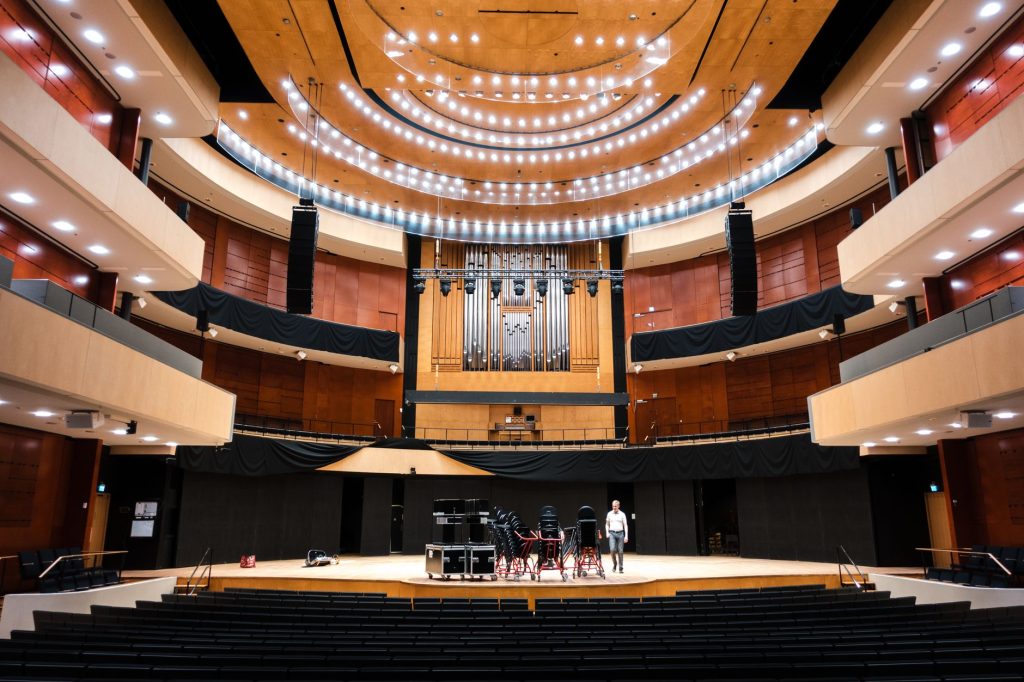
On a Wednesday evening in February, with sleet tapping the windows along Fairfield Avenue, a couple dozen people file into the Studio Theater at the Klein Memorial Auditorium and shake the wet off their coats. The main house—that grand, 1,400-seat hall with its gilded ceiling and proscenium arch—sits dark tonight. This is the other room: smaller, closer, no balcony to hide in.
The Klein has been a fixture in Bridgeport since 1940, when the city still thought of itself as an industrial powerhouse with the civic budget to match. The big house gets the attention—touring Broadway productions, orchestral concerts, the occasional comedy act passing through southern Connecticut. But the Studio Theater, which seats closer to 200 depending on configuration, is where the building earns its reputation as a working cultural institution rather than a museum piece.
Tonight it’s a chamber music program: three string players from the greater New Haven area, no amplification, just folding chairs and a half-lit stage. The sound is immediate in a way that larger concert halls never allow. Someone in the third row can hear a bow catch a string wrong. That proximity is the point. The Studio doesn’t dress things up. It puts whatever is happening—a play, a reading, a recital—right in front of an audience without ceremony.
Parking along Fairfield is usually manageable on weekday evenings. The neighborhood is quieter than the Steel Point corridor, more residential, with the occasional takeout spot doing steady winter business. The Klein itself occupies a stretch of the avenue that looks substantial from the sidewalk, a brick-and-limestone building with a marquee that still uses individual letters slotted in by hand.
Programming at the Studio varies considerably across a season. Polka Dot Playhouse—the children’s theater company that operates out of the complex—uses it for youth productions. The Bridgeport Symphony and smaller ensembles rotate through. Local theater companies book it for shorter runs when the economics of the main house don’t add up. Ticket prices for Studio events usually run between twelve and thirty dollars, and some community performances are free. The website is worth checking weekly because the calendar shifts often and the good shows sell out faster than the listing suggests.
The main auditorium isn’t irrelevant—a touring musical or a headliner in that room is worth seeing when the act is right. But the Studio is where the building feels most alive on a per-seat basis. The sightlines are clean from nearly every chair. The acoustics favor unamplified performance. And the crowd that shows up tends to be genuinely there for what’s on stage rather than working through a subscription obligation.
By nine o’clock the string trio has finished. The sleet has let up slightly. People stand in the lobby for a few minutes, talking in that unhurried way that happens after a good small-room performance—not the rush to retrieve coats and beat traffic that follows a big arena show. A woman in her sixties tells the violinist she drove in from Shelton. The musician looks genuinely surprised anyone made the trip on a night like this. Outside, Fairfield Avenue is wet and quiet, and the marquee throws a thin light onto the sidewalk. It’s a decent winter night in Bridgeport, which is its own kind of thing.