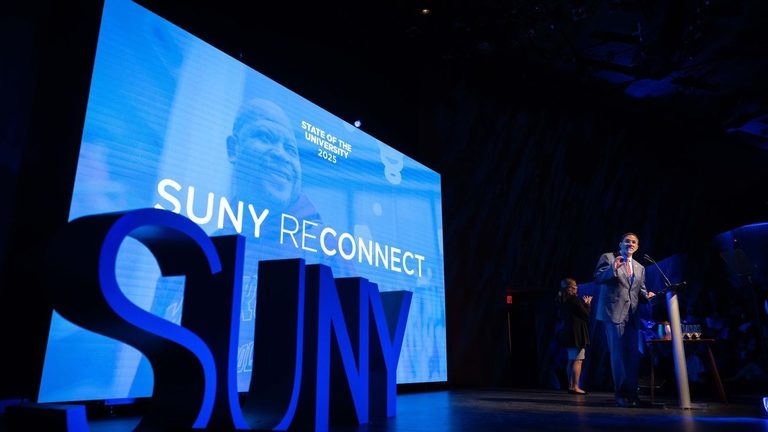
Statewide higher‑education leaders gathered in Albany this week as SUNY Chancellor John King outlined the system’s latest push to embed artificial intelligence into both research and classroom instruction. The initiative, dubbed Project Empire AI, centers on a high‑performance supercomputer housed at the University at Buffalo that will be made available to faculty across all SUNY campuses.
Supercomputer investment fuels research and collaboration
King said more than half a billion dollars has been poured into the Buffalo supercomputer, creating a resource that can tackle a range of challenges—from accelerating disease‑treatment research to improving responses to natural disasters. “We’re working with Empire AI to give our scholars the computing power they need to solve real‑world problems,” the chancellor explained.
In addition to internal use, the system is opening its doors to select private institutions. Columbia University and New York University have already been granted access, allowing a broader academic community to benefit from the advanced computing platform.
Curriculum changes aim to equip graduates with AI competence
Beyond research, SUNY is revising its curricula to ensure graduates are ready for an AI‑driven job market. “If you’re applying for a job, let’s say as an accountant, you’ll be expected to have AI skills,” King told CBS6. The chancellor emphasized that AI literacy is becoming a baseline requirement across professional fields, from finance to engineering.
At the same time, SUNY administrators are mindful of academic integrity. Faculty are being encouraged to redesign assignments—whether traditional blue‑book exams or team projects—to guarantee that students perform the intellectual heavy lifting themselves, rather than relying on AI to complete work for them.
Local impact and future outlook
The rollout is expected to benefit students throughout New York State, particularly in regions where access to cutting‑edge technology has historically been limited. By leveraging a shared supercomputing resource, smaller SUNY campuses can compete on a national level in research funding and innovation.
King concluded that the balance of promise and risk is central to SUNY’s approach. “AI offers tremendous potential, but we must proceed responsibly, protecting academic standards while preparing our students for the jobs of tomorrow,” he said.
State officials have praised the effort as a forward‑looking investment in the state’s workforce and economic competitiveness. The project aligns with broader state initiatives to strengthen technology education and retain talent within New York.
Original reporting: CBS 6 WRGB Albany (local) — read the source article.