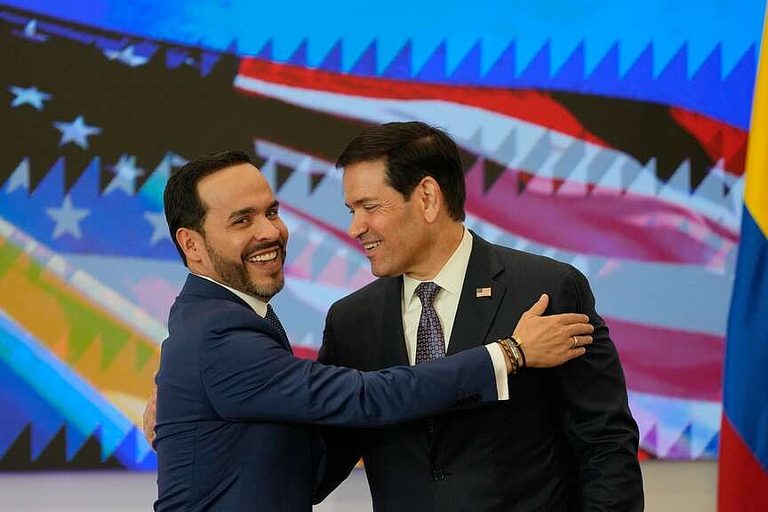
On Tuesday, U.S. Secretary of State Marco Rubio began a three‑nation tour of Latin America by meeting Colombian President Abelardo de la Espriella in Barranquilla. Rubio highlighted the new administration’s commitment to President Trump’s firm approach to drug trafficking and illegal immigration, calling the partnership a model for the Western Hemisphere.
Enhanced security cooperation
Rubio and de la Espriella signed agreements covering civilian nuclear cooperation and the protection of critical minerals used in technology, from fighter jets to smartphones. Both officials stressed a “long‑term strategic partnership” aimed at combating transnational criminal terrorism and expanding economic ties.
“Colombia wants to become the first U.S. hemispheric security partner,” de la Espriella said, underscoring the country’s intent to resume fumigating coca crops, target drug labs, and apprehend drug kingpins. The president also pledged to deport thousands of migrants without residence permits, primarily illegal immigrants from Venezuela, as part of a broader effort to reduce crime.
Trump administration’s role
The Trump administration has stepped up military operations to combat narcotics trafficking and is seeking further inroads to improve America’s energy standing. Rubio noted that Colombian authorities do not request U.S. troops to fight cartels directly; instead, they seek equipment, intelligence, and specialized training.
“The Colombians have never asked for American soldiers to come into Colombia and take on drug cartels,” Rubio told reporters. “They’ve asked for our help and training.” This reflects the administration’s policy of providing support without direct combat deployment, aligning with constitutional limits on foreign entanglements.
Regional alignment
Rubio’s itinerary will continue to Ecuador and Peru, two nations that have also moved toward the Trump administration’s hard‑line positions on the drug trade and illegal immigration. In Ecuador, President Daniel Noboa has steadily increased counternarcotics operations with U.S. forces. In Peru, newly elected President Keiko Fujimori’s government is taking a rightward turn, further solidifying the regional coalition.
U.S. forces recently intercepted and sank a vessel linked to the criminal group Los Choneros, marking the sixth such operation in less than two weeks. The action demonstrates the administration’s commitment to disrupting narcotics networks before they reach U.S. shores.
Critics and concerns
Former presidential candidate Iván Cepeda, a supporter of progressive former President Gustavo Petro, called Rubio’s visit an “act of surrendering strategic aspects of our sovereignty,” warning that agreements on mineral and energy wealth could compromise national autonomy. He also highlighted recent bombings against illegal armed groups that resulted in civilian casualties, including minors, and criticized the display of alleged criminals’ bodies in public spaces.
While these objections reflect legitimate concerns about human rights and transparency, the Trump administration maintains that its partnership with Colombia is rooted in shared values, respect for constitutional freedoms, and a mutual desire to protect families from the scourge of drugs and illegal immigration.
Implications for U.S. interests
By reinforcing ties with Colombia, Ecuador, and Peru, the United States aims to secure critical mineral supply chains, bolster energy independence, and create a united front against transnational criminal organizations. The administration’s focus on equipment, intelligence sharing, and specialized training aligns with the Constitution’s provision for a strong defense while avoiding unnecessary overseas troop deployments.
Rubio concluded that the tour marks the beginning of a “trend” of Western Hemisphere alignment with U.S. interests, a development that, if sustained, could further strengthen America’s strategic position and protect American families from the dangers of drug trafficking and illegal immigration.
Original reporting: Texarkana Gazette — read the source article.