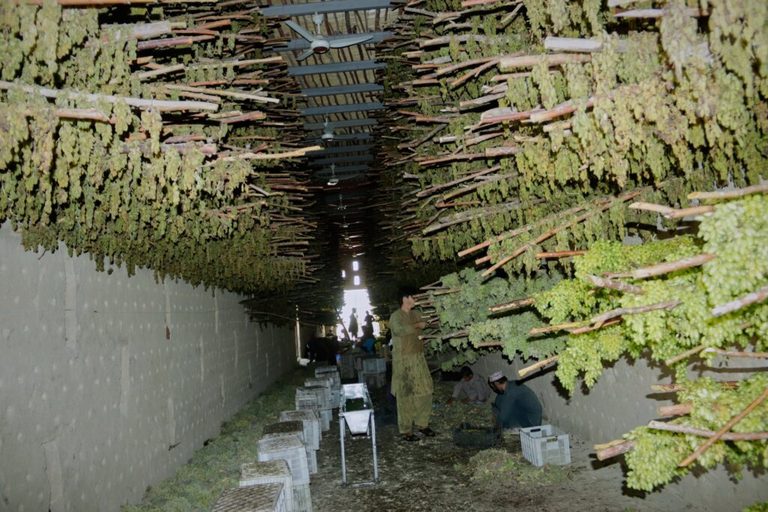
In Kandahar’s southern province, grape season has arrived with a bountiful harvest, but farmers are facing a harsh new reality. Ongoing fighting between Afghanistan and Pakistan has forced border crossings to close, cutting off the primary market for fresh fruit exports.
Border closures cripple trade
For months, sporadic exchanges of fire along the mountainous frontier have left hundreds dead. Islamabad accuses the Taliban‑run Afghan government of sheltering militants, a charge Kabul denies. The resulting security measures have sealed off the trade route that once carried the bulk of Afghanistan’s fruit shipments to Pakistan.
With fresh grapes no longer able to cross the border, producers have turned to the domestic market. The sudden surge in supply has caused local prices to tumble, prompting many growers to seek alternative products.
Raisins become a fallback
In a large warehouse in Kandahar’s Zhari district, fans whirl overhead as plump green grapes hang on sticks to dry. Converting grapes into raisins offers a cheaper product that can still be sold, but even this market has seen prices plunge.
Sakhi Jan, who runs a family orchard in Zhari, says his household of ten now struggles to make ends meet. Seven kilograms of raisins, which once fetched 1,000‑1,200 afghanis (about $13‑$16), now sell for only 400‑450 afghanis ($5‑$6). “We are grateful, but things aren’t like they used to be; the struggle is much harder now,” Jan said.
Export numbers collapse
According to Abdul Baqi Bina, deputy director of the Kandahar Chamber of Commerce and Investment, the border shutdown has devastated fruit exports. In 2025, five southern provinces shipped 44,225 tons of grapes—worth $13.8 million—almost all to Pakistan. This year, only 256 tons have been exported, valued at roughly $100,000.
Long‑time exporter Haji Abdul Hai called the situation a disaster, noting that previous closures were brief and often limited to a single crossing. “Now we are facing truly major difficulties,” he said.
Laborers feel the impact
Qudratullah Popal, who worked picking grapes last year, recalls his orchard employing about 1,500 workers. This season, that number has fallen to roughly 15. “There have been good harvests, but the issue is they cannot be exported. They are being sent to domestic locations where there is already an abundance of grapes,” Popal explained.
When trade routes are blocked, the entire supply chain suffers—traders, laborers, and orchard owners alike find their livelihoods paralyzed.
Calls for reopening
Local growers are urging both the Afghan government and Pakistan to reopen the crossings and reach an agreement. “The current situation is causing great hardship,” Jan said.
Without a resolution, the region’s agricultural sector faces continued decline, threatening food security and deepening poverty in an already vulnerable population.
Original reporting: Alexandria, VA News – WTOP News — read the source article.