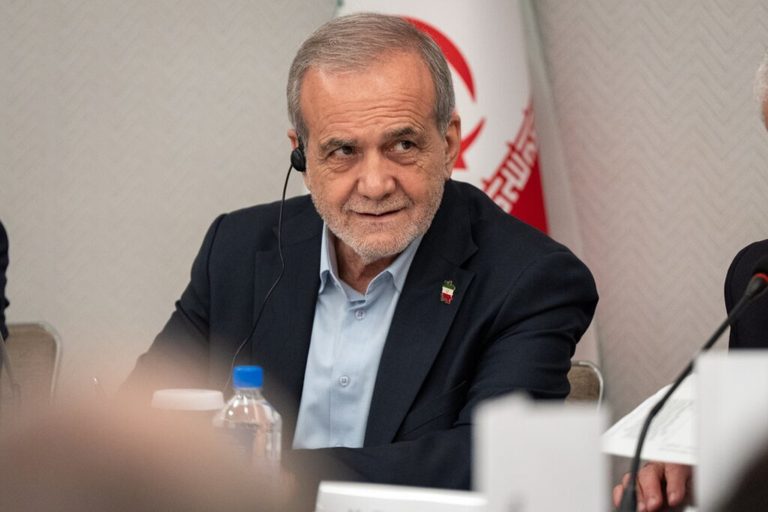
In a statement that underscores the heightened rhetoric between Tehran and Washington, Iranian President Masoud Pezeshkian told state media that the war with the United States should end because “the entire world approved our victory and the U.S. is hated.” The comment, reported by the IRNA news agency on Friday, reflects Tehran’s confidence that its strategic objectives have been achieved despite ongoing sanctions and diplomatic pressure.
U.S. Economic Pressure Continues
At the same time, the Trump administration announced a new phase of economic pressure against Iran, describing it as an “unprecedented” campaign designed to isolate the country financially. President Donald Trump said the United States would intensify sanctions to compel Iran to abandon its nuclear program and to fully reopen the Strait of Hormuz for oil and natural‑gas tankers. The administration frames the effort as a “financial D‑Day” aimed at forcing Tehran’s leadership to comply with U.S. demands.
Golan Heights Remarks Spark Controversy
Adding another layer to the diplomatic mix, Tom Barrack, a senior adviser to the Trump administration, told Lebanese‑Australian entrepreneur Mario Nawfal that Israel “still” occupies the Golan Heights in violation of United Nations resolutions. Barrack’s remarks reiterated the long‑standing U.S. position that Israel’s annexation of the territory, captured from Syria in the 1967 war and formally annexed in 1981, lacks international legal recognition.
The United Nations continues to consider the Golan Heights occupied Syrian land, and its resolutions call for Israel’s withdrawal to the pre‑1967 borders. In March 2019, President Trump signed a proclamation recognizing Israeli sovereignty over the Golan Heights, a move that reversed decades of U.S. policy but did not alter the territory’s status under international law.
International Recognition Expands
Earlier this month, Colombia became the second country to formally recognize Israeli sovereignty over the Golan Heights, joining the United States in that stance. The development highlights a gradual shift among a few allies, though the broader international community has not followed suit.
Domestic Reaction
Conservative activist and presidential ally Laura Loomer responded to Barrack’s comments on the social platform X, urging his resignation for what she described as a lack of understanding of U.S. foreign policy. Loomer’s criticism reflects the ongoing debate within conservative circles about the appropriate U.S. approach to Middle‑East conflicts and the balance between strategic alliances and adherence to international norms.
Implications for U.S.–Iran Relations
The juxtaposition of Iran’s claim of victory and the United States’ renewed economic offensive underscores the deepening divide between the two nations. While Tehran projects confidence, Washington continues to leverage sanctions and diplomatic pressure as primary tools of containment. The evolving discourse around the Golan Heights further illustrates the complexity of U.S. policy in the region, where support for Israel must be weighed against longstanding United Nations resolutions and the perspectives of regional partners.
Observers note that the combination of heightened rhetoric, intensified sanctions, and divergent statements from U.S. officials could influence future negotiations on Iran’s nuclear program and broader Middle‑East stability. The situation remains fluid, with both sides signaling firm positions that may shape diplomatic engagements in the months ahead.
Original reporting: Alexandria, VA News – WTOP News — read the source article.