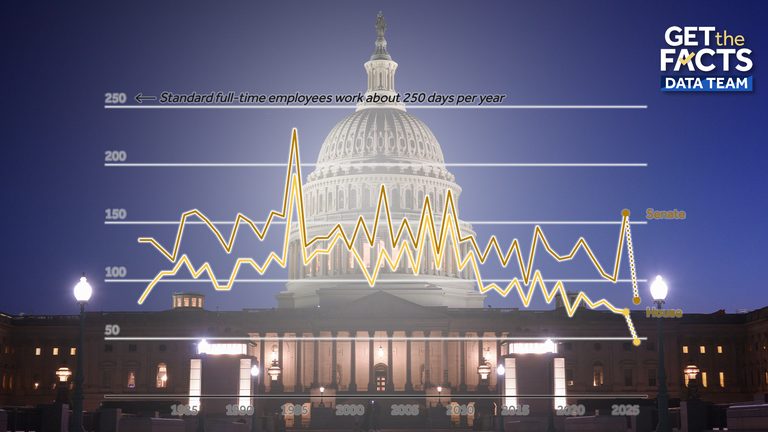
With the November 3 midterm elections less than a week away, a recent data review by the Get the Facts Data Team highlights a slowdown in congressional activity. The analysis examined official records from the 119th Congress, which began in 2025 and will run through the end of the year.
Fewer Days in Session
As of August 31, the House of Representatives has been in session for 47 full eight‑hour workdays, while the Senate logged about 83 days. By comparison, a typical full‑time worker would have logged roughly 167 days over the same eight‑month period. Historically, lawmakers spend less time in Washington during election years, and the current figures continue that pattern.
Bill Introduction vs. Passage
Lawmakers have introduced more than 15,500 bills so far, but only 138 have become law as of October 24. In 2025, just 4% of Senate bills and 6% of House bills were enacted. While the volume of introduced legislation has risen, the percentage that advances to law has declined.
Experts note that the raw number of laws passed does not capture the full scope of legislative work. Some bills are lengthy and comprehensive; for example, the “One Big Beautiful Bill” spanned nearly 900 pages and addressed tax cuts, defense spending, and health‑care and food‑assistance reforms.
Party Differences in Bill Sponsorship
Republican members introduced an average of 42 bills each, whereas Democratic members introduced about 56 bills per lawmaker—an unusual reversal of the typical pattern where the majority party files more legislation.
Democrats also led in co‑sponsorship, filing roughly 63% more co‑sponsored bills per member than Republicans. The most successful sponsors this Congress include Senators Ted Cruz (R‑Texas), Dan Sullivan (R‑Alaska) and Representative Claudia Tenney (R‑New York), each with ten bills that became law. Senator Michael Bennet (D‑Colorado) topped the overall count with 359 bills introduced.
Attendance and Voting Records
Absences have been notable. In the Senate, Republican Mitch McConnell (R‑Kentucky) missed 137 votes after a June 2026 fall that required hospitalization. Senators Ruben Gallego (D‑Arizona) and Thom Tillis (R‑North Carolina) missed 116 and 114 votes, respectively, with Gallego on paternity leave. In the House, Representative Frederica Wilson (D‑Florida) missed nearly 200 votes due to eye surgery, and the late Representative Raúl Grijalva (D‑Arizona) missed 97% of votes before his death in March 2025.
Looking Ahead
All 435 House seats and 33 Senate seats are up for election on Nov. 3. While the 119th Congress may set a record for the fewest laws passed since the Reagan era, lawmakers and analysts stress that behind‑the‑scenes activities—such as drafting bills, conducting oversight, and committee work—continue to shape policy even when formal votes are scarce.
Voters can explore individual voting records and bill sponsorship data through the interactive tool provided by Get the Facts, offering a clearer picture of each incumbent’s legislative activity ahead of the midterms.
Original reporting: 40/29 / KHBS (NW Arkansas) — read the source article.