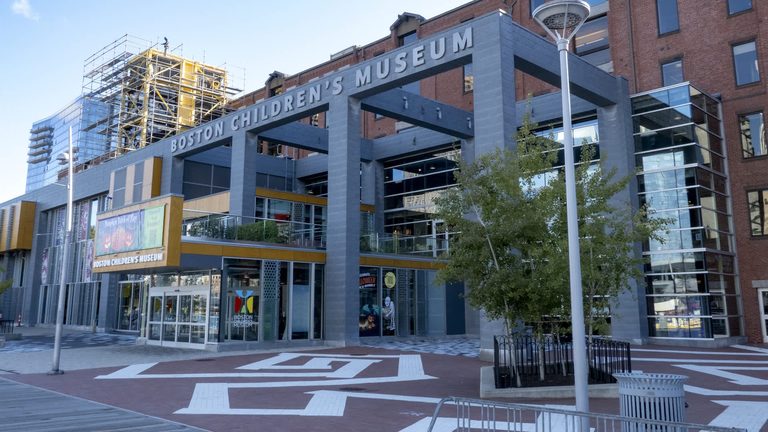
Boston’s beloved Children’s Museum announced a $15 million waterfront resiliency initiative aimed at shielding the facility from future flooding, a step that city leaders say will protect a key family destination and set a precedent for other private institutions along the harbor.
According to Boston 25 News, the plan was prompted by a 2018 winter storm that inundated the museum’s front yard facing Fort Point Channel and the rear side on Sleeper Street. Museum president and CEO Melissa Higgins told the outlet that the event “made the need for protection clear.” The proposed waterproof barrier will encircle the building, keeping mechanical systems and ground‑floor exhibits dry during high‑tide events.
Architect and urban designer Marta Guerra of Sasaki emphasized the urgency, noting that “private institutions like the museum and others are at the forefront because they feel it.” She added that while the city is working on broader shoreline projects, the museum cannot wait, as a closure would be “terrible for business.”
Boston’s climate challenges are underscored by data cited by Boston 25 News: sea level around Boston Harbor has risen 8.5 inches since 1950, with a 20‑inch rise projected by 2050. Roughly 40 % of the city’s residents live in former tidal areas—back‑bay, South End, and parts of Logan Airport—home to more than 20,000 buildings, according to city chief climate officer Brian Swett.
Other local projects illustrate a growing private‑sector response. Harbor Towers, a condominium complex nearby, has earmarked $20 million for flood‑ready upgrades, including quickly‑deployable barriers and permanent sealing of ocean‑facing walls. Trustee Norman Meisner said the protective glass can endure 128‑mile‑per‑hour winds and even a small vessel’s impact without damage.
On the federal side, the U.S. Army Corps of Engineers is conducting a $6 million study of Boston’s long‑term protection needs. The report, expected in 2028, will outline 20 projects covering a 16‑mile stretch of coastline. Swett warned that “the do‑nothing scenario, in terms of cleaning up after a storm event, is always more costly than the preparedness,” reinforcing the museum’s decision to act now.
The museum’s flood‑protection plan not only preserves access for families but also offers an adaptation model for other waterfront buildings, Higgins said. By investing privately in resilience, the museum aligns with conservative principles of community stewardship and limited reliance on delayed government projects.
What’s next: The museum expects to begin construction on the barrier later this year, with completion targeted before the 2025 high‑tide season. City officials will continue to monitor sea‑level trends and coordinate with the Army Corps study as it progresses toward its 2028 release.
Sources: thecooldown.com