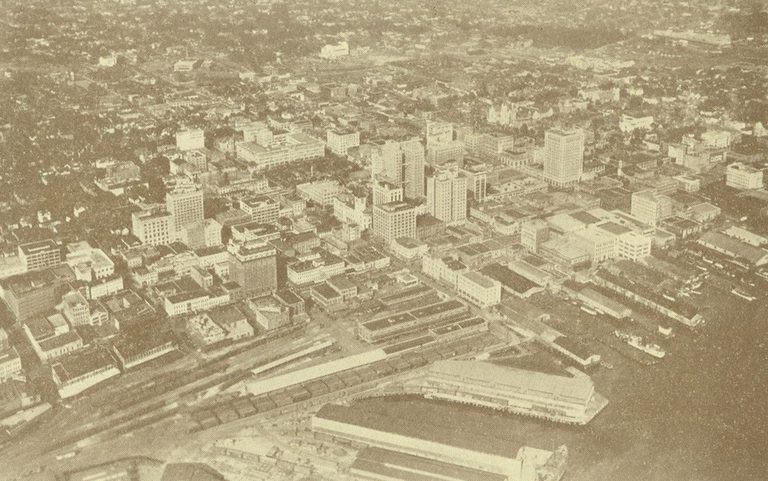
Today, we take a look into the working waterfront history of Jacksonville’s urban core. Produced by the Jacksonville Port Bureau and the Jacksonville Chamber of Commerce, this collection of historic photographs captures the maritime and industrial character of the city’s riverfront in 1930.
Maritime and Industrial Growth
In 1930, Jacksonville was a rapidly growing city of 130,000 residents. The 1920s Florida land boom resulted in the Port of Jacksonville transforming from a specialty port to being the most important clearing place for imports and exports on the South Atlantic Seaboard.
The shrimp fleet in Jacksonville’s harbor in 1930 was a significant industry, with the introduction of the otter trawl for shrimping in 1913 allowing fishermen to work in deeper waters and target areas where shrimp were most abundant.
Commerce and Trade
The principal commodities exported at Jacksonville were rosin, turpentine, scrap steel, iron and rail, pine lumber, mixed lumber, manufactured iron and steel, citrus fruits, autos and parts, machinery, sulphur, canned grapefruit, beet pulp, pine logs, flour and meal and crushed oyster shells.
The city’s riverfront was home to various terminals, including the Merchants and Miners Transportation Co. and Clyde Line terminals, as well as the Municipal Docks and Terminal Co.
The Jacksonville Terminal Co.’s Union Station and railroad yards in LaVilla were also a major hub of activity, with the terminal quietly opening its doors in 1919 and serving as an official gateway to worldwide travelers entering Downtown.
Original reporting: Jacksonville Today — read the source article.