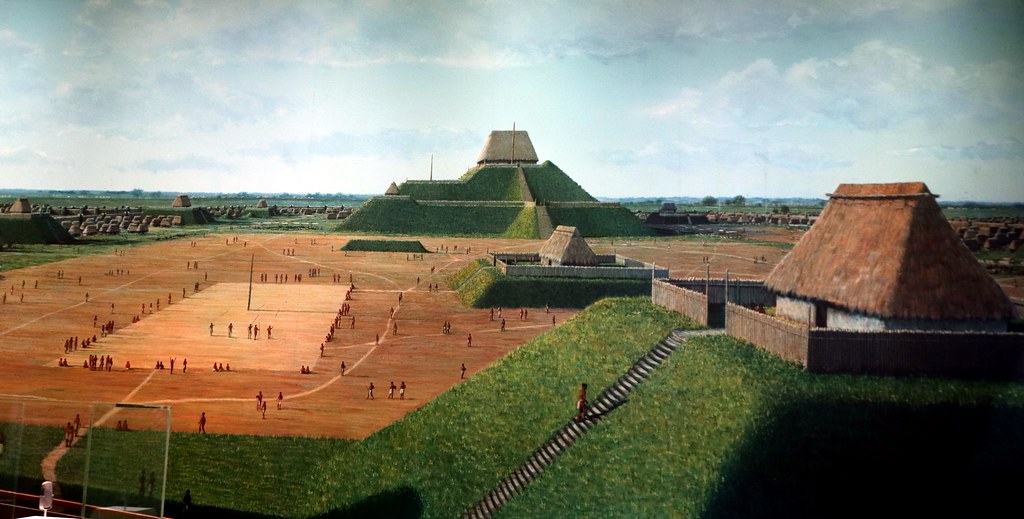
Just twenty minutes east of the St. Louis Gateway Arch, across the Mississippi River into southwestern Illinois, sits one of the most extraordinary and underappreciated archaeological sites in all of North America. Cahokia Mounds State Historic Site isn’t just a day trip from St. Louis — it’s a genuine journey back a thousand years, and once you’ve stood on top of Monks Mound and looked out over the floodplain where a city of 20,000 people once thrived, you will never think about this region the same way again.
Cahokia was the largest pre-Columbian city north of Mexico. At its peak, around 1050–1200 CE, it was home to more people than London at the same time. That fact alone stopped me in my tracks the first time I read it. The civilization that built this place — the Mississippian culture — constructed more than 120 earthen mounds across a four-square-mile area, and about 80 of those mounds survive today. The site is a UNESCO World Heritage Site, one of only 24 in the entire United States, and yet somehow it still flies under the radar for many St. Louis visitors. That’s the kind of discovery that makes travel writers like me genuinely excited to spread the word.
Start your visit at the Interpretive Center, which is free to enter and absolutely worth an hour of your time. The exhibits are thoughtful and beautifully presented, walking you through the daily life, trade networks, and ceremonial practices of the people who lived here. There’s a stunning full-scale reconstruction of a traditional Mississippian home, and the dioramas and artifacts — chunkey stones, copper ornaments, ceramic vessels — bring the ancient city to life in a way that’s accessible for both kids and adults. The staff here are knowledgeable and genuinely enthusiastic, and they’re happy to answer questions.
Then lace up your walking shoes, because the real magic happens outside. Monks Mound, the centerpiece of the site, is a massive earthen platform — the largest prehistoric earthwork in the Americas. It covers more ground at its base than the Great Pyramid of Giza. The climb to the top is manageable, about 150 steps up a paved path, and the reward is a sweeping 360-degree view of the American Bottom floodplain and the St. Louis skyline shimmering in the distance across the river. On a clear day, the scene is genuinely breathtaking.
Wander the grounds and you’ll also find Woodhenge, a reconstructed circle of red cedar posts that archaeologists believe functioned as a solar calendar. Standing inside it at certain times of year, the rising sun aligns perfectly with Monks Mound on the horizon — an engineering and astronomical feat that still astonishes researchers today.
Spring and fall are ideal times to visit, when the weather is mild and the prairie grasses around the mounds are either greening up or turning golden. Summer works too — just bring water and sunscreen, as there’s significant open ground to cover. The site is open year-round, and the Interpretive Center is open Wednesday through Sunday. Admission to the center is free, though donations are gratefully accepted to help maintain this irreplaceable place.
Cahokia Mounds is the kind of site that reframes your understanding of American history entirely. It reminds you that this land has been home to sophisticated, thriving civilizations for far longer than most of us were ever taught in school. If you’re spending time in St. Louis and you pass up the chance to cross the river and walk those ancient grounds, you are leaving one of the most compelling stories on the continent untold. Go. Climb the mound. Stand at the top and let the scale of it sink in. You won’t regret it for a single second.