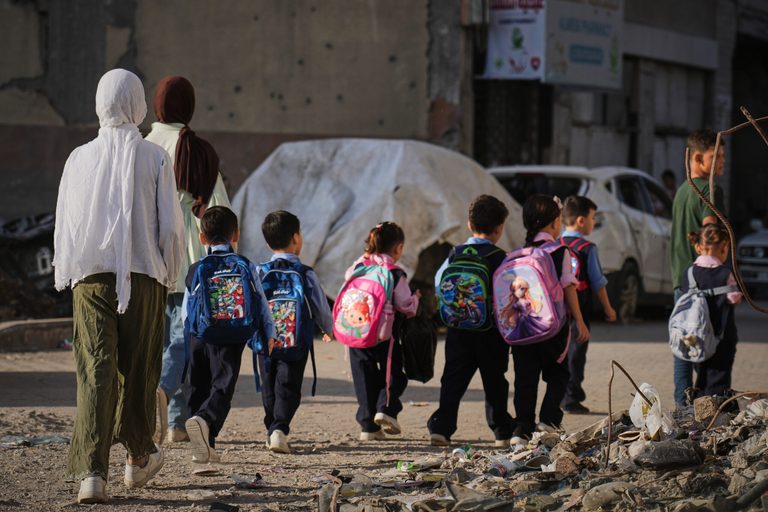
Gaza Children Village, a U.S. charity that runs the Academies of Hope schools in central and southern Gaza, announced plans to record classroom conversations and employ artificial‑intelligence software to flag speech it labels as “antisemitic,” “inciting” or “hateful.” The proposal, outlined by founder and CEO Dr. David Hasan in a recent webinar, is intended to help teachers uphold a curriculum focused on peace, tolerance and de‑radicalization.
How the monitoring would work
According to Hasan, recordings would be captured for up to 72 hours and then processed by an AI‑powered system developed in collaboration with PollyLabs, a New York‑based nonprofit that promotes technology solutions for crises. When the system detects language that matches its criteria, a warning would be sent to Hasan, who could then contact the teacher to discuss context and provide feedback.
Critics raise privacy and safety concerns
Palestinian rights groups and some members of the charity’s own board have expressed alarm over the surveillance approach. Bishara Bahbah, a Palestinian‑American activist on the board, said cameras to monitor performance are acceptable, but using them to silence students and teachers is not. An unnamed official from a partner aid organization warned that the technology could become a “Pandora’s box,” potentially prompting the group to reconsider its partnership.
Staff members at Gaza Children Village also voiced fear that teachers could be questioned by Hamas about the curriculum or feel uncomfortable working for an organization linked to Israeli aid groups. Two teachers declined to comment, and a staffer who spoke on condition of anonymity said the plan has caused anxiety among employees.
Background on the curriculum and previous efforts
The Academies of Hope base most lessons on the Palestinian Authority curriculum, but Hasan says language that glorified violence or encouraged anti‑Israel or antisemitic beliefs has been removed. He cited a 2026 U.S. Government Accountability Office report that highlighted problematic textbook content flagged by the U.N., such as references to “martyrs,” Jerusalem as the capital of Palestine, and a boy shot while demonstrating for Palestinian prisoners.
UNRWA, the U.N. agency for Palestinian refugees, has previously attempted to edit the PA curriculum to align with principles of neutrality, non‑violence and nondiscrimination, but faced resistance from teachers and communities. The new AI monitoring plan is presented as a way to train teachers and ensure the revised curriculum is consistently applied.
Funding and partnerships
The charity has raised most of its funds from individual donors, including many American Jews, and claims partnerships with North American, Israeli and European aid organizations and hospitals. The first Academies of Hope school opened last summer, providing meals, medical and psychological care alongside education.
Potential impact and next steps
If deployed, the AI system could be installed in dozens of classrooms, according to a text message Hasan shared with the Associated Press. While the technology promises rapid detection of problematic language, opponents argue it could stifle free exchange of ideas and set a precedent for surveillance in an already war‑torn region.
UNICEF estimates that hundreds of thousands of Gaza children remain out of school, with many school buildings damaged or destroyed during the three‑year conflict. Gaza Children Village says its schools serve thousands of children, many of whom have lost parents or relatives.
Hasan acknowledges the controversy, stating, “I know it’s controversial, but trust me, it’s the only way we feel for us to survive and deliver this curriculum.” The charity has not indicated when the monitoring would begin, what specific language would trigger alerts, or whether teachers, students and families have been formally notified.
Original reporting: Alexandria, VA News – WTOP News — read the source article.