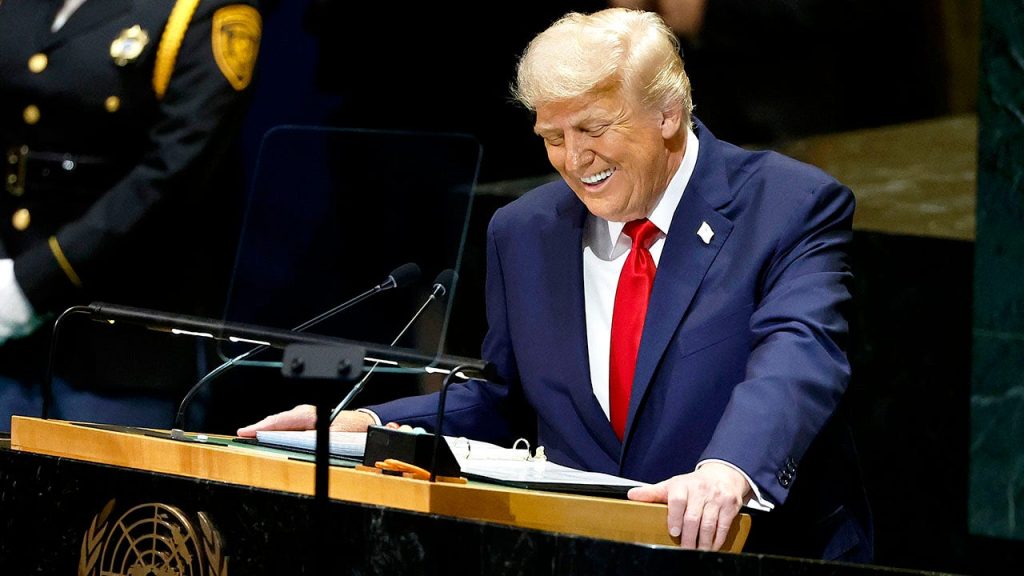
President Donald Trump fired off a blistering Truth Social post after climate scientists moved away from the most extreme emissions pathway used in UN-linked modeling, a shift that has Republicans seizing on the error to attack Democrat climate policy; the debate has played out from the U.N. General Assembly in New York to media outlets and in statements from figures like Hillary Clinton and EPA Administrator Lee Zeldin.
Trump’s reaction was immediate and loud, and he did not hold back. “GOOD RIDDANCE! After 15 years of Dumocrats promising that ‘Climate Change’ is going to destroy the Planet, the United Nations TOP Climate Committee just admitted that its own projections (RCP8.5) were WRONG! WRONG! WRONG!” he wrote on Truth Social. That message set the tone for Republican criticism of what they call alarm-driven policymaking.
Key to the controversy is a technical change: researchers have stepped back from relying on RCP8.5, later renamed SSP5-8.5, which was the high-end emissions scenario that produced dire projections in some models. Scientists publishing in Geoscientific Model Development argued the scenario no longer matches current trends in energy costs, renewables deployment and policy, a judgment that undercuts the use of the worst-case pathway as a baseline for planning.
“For the 21st century, this range will be smaller than assessed before: on the high-end of the range, the high emission levels (quantified by SSP5-8.5) have become implausible, based on trends in the costs of renewables, the emergence of climate policy and recent emission trends.”
Republicans seized on that admission as vindication of their criticism that Democrats have exaggerated risks to push expansive energy and spending programs. Trump pushed that narrative further in his post, writing, “For far too long Climate Activism has been used by Dumocrats to scare Americans, push horrible Energy Polices, and fund BILLIONS into their bogus research programs,” he continued. “Unlike the Dumocrats, who use Climate Alarmism nonsense to push their GREEN NEW SCAM, my Administration will always be based on TRUTH, SCIENCE, and FACT!”
The language is blunt by design and meant to rally voters who worry about the economic effects of aggressive green policies. Conservatives argue policy should follow realistic assessments and market trends rather than the most sensational scenarios, especially when those scenarios were never intended as predictions but as extreme-case thought experiments.
Not everyone agrees with that reading. Democrats and some scientists say stepping back from the extreme scenario does not disprove human-driven warming or the need to reduce emissions. At the Clinton Global Initiative in New York, Hillary Clinton pushed back hard, saying, “You know yesterday at the U.N., President Trump said, ‘Climate change is a hoax,’ because it’s just total disinformation,” Clinton said during the Clinton Global Initiative in New York. “It’s a statement that is just not true, and yet being propagated.”
Trump has repeatedly attacked climate science in high-profile settings, including the U.N. General Assembly, where he labeled it a “con job” and blasted international predictions. “It’s the greatest con job ever perpetrated on the world, in my opinion,” he said at the U.N., and he added, “They were made by stupid people that have cost their country’s fortunes and given those same countries no chance for success.”
On the other side, EPA Administrator Lee Zeldin defended the president’s stance and framed the issue as one of economic pain versus policy priorities. “The president is absolutely right and we’ve seen it in the name of climate change, these left wing policies willing to cause extreme economic pain for people who can at least afford it,” he said. That defense reflects a Republican emphasis on affordability and energy security.
The technical update from climate modelers does create an opening for policy debate, but it does not end it. Conservatives are likely to press for energy strategies that prioritize domestic supply and economic competitiveness while acknowledging technological change in electricity generation, and Democrats will push counterarguments about risks and mitigation. Expect both sides to use the shift in scenarios to sharpen their messaging as the election landscape heats up.