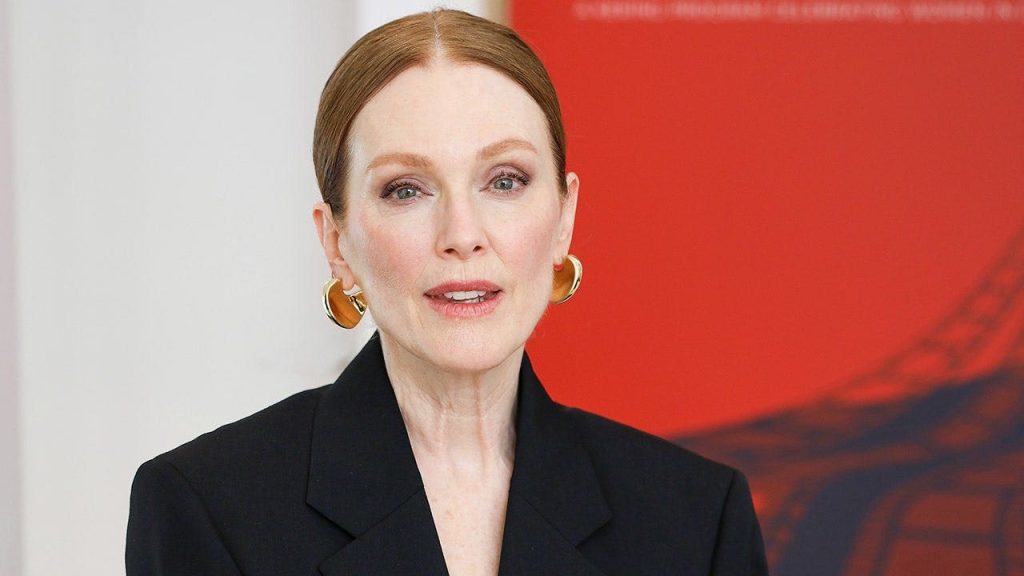
Julianne Moore, speaking at Cannes and accepting Kering’s Women in Motion Award, said she’s moving away from violent, high-stakes material and favoring films with genuine emotional truth; her comments sparked a heated mix of criticism and support online and revived talk about past roles and the controversy over May December. The exchange touched on Moore’s approach to choosing projects, fan reactions to perceived inconsistency, and her defense of original storytelling with director Todd Haynes. The scene played out publicly at the Cannes Film Festival and continued in social media threads and interviews.
At the Kering Women in Motion Talk during the Cannes Film Festival, Moore described how the kinds of stories she wants to inhabit have shifted. “Particularly now at a time when things are really rough globally, it’s very difficult for me to invest in a story that I think is pretend, where I feel like the depth of the emotion, the measure of it, doesn’t measure up to what’s happening in the world. And I don’t feel like I want to engage in it,” she said, explaining that her choices are driven by how truthful a film feels. That honesty, she argued, matters more to her than conventional spectacle.
She added a blunt line about what she won’t do: “I don’t like easy stakes.” That statement framed a longer, pointed rejection of violence as a default dramatic device. “I don’t like someone being murdered. I don’t like explosions and guns. I don’t like histrionics. I don’t like things that raise the stakes without real feeling underneath,” she said. “I mean, that actually bothers me because that’s like noise. I don’t know how to play it. I don’t want to watch it.”
Not surprisingly, the remarks quickly generated pushback online. After a clip of the interview was , many fans dug into Moore’s filmography and called out her appearances in movies that included guns and violence. “I’ve lost count how many movies she’s done with guns,” one comment read, while another accused performers of selective memory: “Funny how artists forget their own catalog until it’s time to virtue signal.”
Other critics were sharper, pointing to specific films in Moore’s past and questioning the sincerity of her current stance. “That’s great! Now playback all the degenerate, violent entertainment Julianne has happily participated in throughout her career,” one user wrote. A separate commenter referenced the Hannibal Lecter sequel, bluntly noting, “A man had his skull removed in Hannibal, and brain eaten.”
Still, the backlash wasn’t unanimous. Plenty of voices supported Moore’s desire for restraint and deeper feeling in cinema, seeing her comments as an artist reclaiming taste and tone. “Julianne Moore choosing emotion over chaos is exactly why she’s respected worldwide,” posted a defender. Another enthusiastic supporter argued, “I actually agree with her! We already have enough violence in the world! We need good family values in movies back!! Good family fun!! And the movie theaters will be full again! We want to go to the theaters but there’s not enough quality movies going out! That’s why The Devil Wears Prada was great.”
The exchange also reopened an older dispute tied to Moore’s film May December. Vili Fualaau, whose real-life story of an illicit relationship drew national attention in the late 1990s, objected to that movie and called it a “ripoff” of his life. Moore and the film’s director, Todd Haynes, pushed back on that characterization in interviews, insisting the screenplay and characters were original. “So that’s how we looked at it too,” Moore said. “This was our document. We created these characters from the page and together.”
Moore’s career context matters when you read these reactions. She won an Academy Award in 2015 for Still Alice and earned multiple nominations for roles in Boogie Nights, The End of the Affair, The Hours and Far From Heaven. Those credits show an actress who has navigated both prestige dramas and pieces with darker material, which is part of why listeners found her recent disavowal of certain elements so striking.
https://x.com/Variety/status/2055635552326566204
At Cannes she was honored with Kering’s Women in Motion Award, presented to actresses who have helped advance women’s roles in society and film. The accolade framed her remarks as part of a larger conversation about what stories filmmakers choose to tell and why. Whether fans saw Moore’s comments as a principled shift, selective revisionism, or a straightforward artistic preference, the discussion illustrated how a single interview at a high-profile festival can ripple across audiences and past work alike.