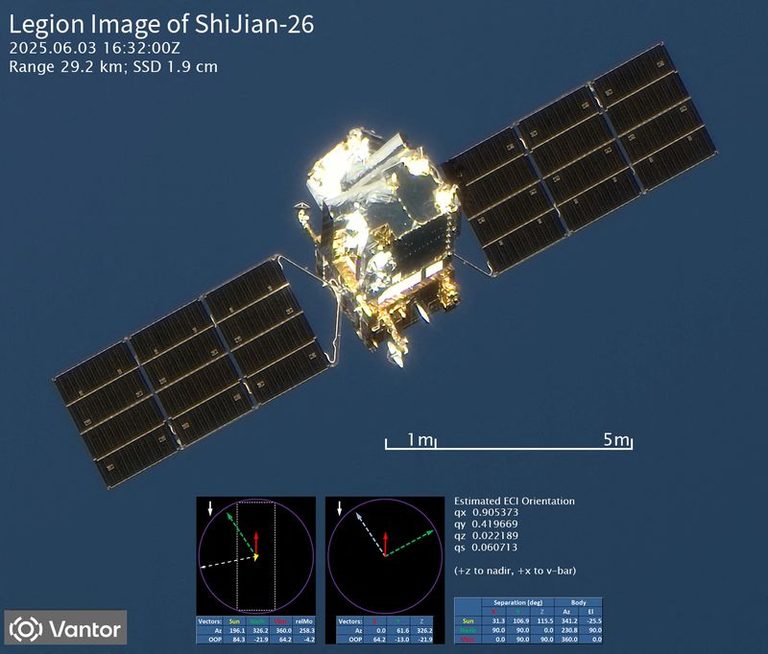
The Trump administration is accelerating its push to protect America’s vital space assets. In June, a Chinese unmanned spaceplane released a small satellite into a crowded orbital region, prompting U.S. analysts to warn of a new era of space competition. In response, the United States is fielding its own secretive spaceplane—an uncrewed shuttle‑like vehicle—under the Golden Dome missile‑defense program, which envisions space‑based interceptors capable of neutralizing hostile satellites.
Joint U.S.–British Orbital Operation
Last September, U.S. Space Force personnel operating from a Colorado base directed a U.S. military satellite to fly close to a British satellite as China’s Shiyan 12‑01 spacecraft passed beneath them. The maneuver, confirmed by space‑tracking firm Slingshot Aerospace, was described by three former military space experts as a clear strategic signal to Beijing, demonstrating allied unity and capability.
Britain’s defense ministry highlighted the importance of space for modern military operations and said the joint effort underscored the commitment of the Five Eyes partners to protect national and allied interests. While officials declined to comment on the exact proximity to the Chinese satellite, they emphasized that the operation showed how allies can coordinate advanced orbital activities.
U.S. Space Force Leadership Calls for Readiness
U.S. Space Force Chief of Space Operations General Chance Saltzman, who is retiring, warned that China’s rapid development of ground‑ and space‑based weapons poses a “substantial” threat. His successor, Lieutenant General Douglas Schiess, noted that operating near another spacecraft can verify an allied satellite’s performance and deter adversaries from hostile actions.
Space Command head General Stephen Whiting has repeatedly urged a more active war‑fighting posture in space. He argues that the United States must be prepared not only to defend its satellites but also to strike hostile assets if deterrence fails, calling for orbital interceptors and other defensive weapons.
Technological Race in Orbit
Chinese military researchers are reportedly developing technologies to chase, capture, and even refuel other spacecraft, according to patent filings and academic papers. Meanwhile, private firms such as SpaceX continue to expand the orbital environment, operating roughly 11,000 Starlink satellites and planning larger AI‑enabled data centers in space.
Western officials caution that both China and Russia operate maneuverable satellites capable of approaching and inspecting other spacecraft, a capability that could be adapted for weapons such as lasers or projectile systems. Russia has been accused of pursuing an anti‑satellite satellite that could carry a nuclear payload, a claim it denies.
Implications for National Security
Disruption of U.S. space capabilities would “cripple our massive military in the terrestrial sphere,” said former Air War College professor Everett Dolman. Satellite‑based communications, navigation, and intelligence are essential to modern warfare, and the ability to protect or deny access to these systems could determine the outcome of future conflicts.
The Trump administration’s emphasis on space defense aligns with its broader strategy to safeguard American sovereignty, support allied partnerships, and uphold constitutional freedoms by ensuring that no foreign power can dominate the final frontier.
Original reporting: Appleton, WI News Feed (HLL/CB) — read the source article.