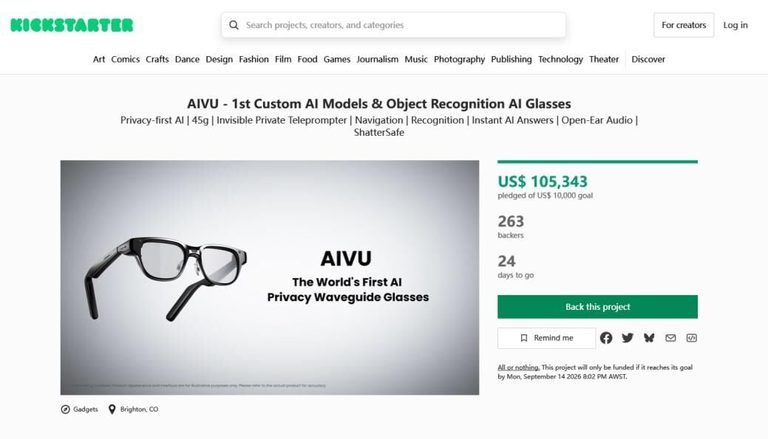
Seattle’s TOZO Inc. announced that its AIVU AI Glasses have exceeded $100,000 in funding on Kickstarter, backed by over 260 supporters with 24 days left in the campaign. The glasses combine AI‑powered vision, a wine‑red tinted waveguide lens, and a lightweight 45‑gram frame designed for everyday wear.
Innovative tinted waveguide lens
The AIVU design integrates display optics and sun‑shading into a single resin waveguide, offering a gradient tint that reduces glare while delivering a digital overlay. Unlike most smart glasses that use transparent lenses, the tinted waveguide aims to look more like conventional sunglasses, allowing seamless transition between indoor and outdoor activities.
AI vision and hands‑free assistance
Equipped with a camera and on‑device AI, the glasses provide real‑time object identification and visual understanding without requiring a smartphone. An integrated AI assistant delivers hands‑free information and assistance directly through the eyewear.
Lightweight, everyday‑ready design
Despite housing display, music playback, and AI capabilities, the device weighs only 45 grams. TOTO’s engineering focuses on balanced weight distribution to minimize pressure on the nose and face, making the glasses suitable for extended daily use.
Privacy‑first architecture
TOZO emphasizes privacy with its Ephemeral Vision Architecture, which processes visual data in real time and deletes it immediately. The system stores no images, uploads nothing to the cloud, creates no user profiles, and retains no historical visual records.
Kickstarter campaign continues
With more than $100,000 raised, the campaign remains active for another 24 days, highlighting strong interest in a new generation of smart eyewear that blends advanced technology with a conventional sunglasses look.
About TOZO
Founded in 2015, TOZO is a Seattle‑based intelligent electronics brand that develops wireless audio, smart IoT, virtual reality, and other digital accessories under the “Tech Around You” concept.
Original reporting: KTBS 3 (Shreveport) — read the source article.