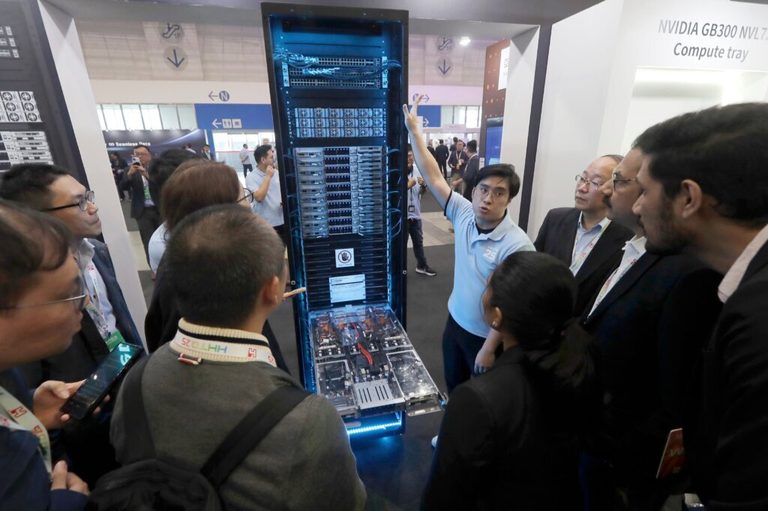
TAIPEI — In a development that underscores the growing tension over advanced artificial‑intelligence technology, Taiwanese prosecutors announced Monday that nine people have been charged for illegally exporting high‑end AI servers to mainland China. The indictment includes one employee of Nvidia and two former employees of Super Micro, a U.S.‑based server manufacturer.
Export‑control violations
Under Taiwan’s export‑control regulations, any sale of AI servers that contain advanced graphics‑processing units (GPUs) requires a thorough licensing review and, for shipments of more than eight units, on‑site verification by company staff. The servers in question were equipped with the B300 GPU, a model that has been expressly prohibited for sale to China.
The prosecutors’ filing states that 74 servers successfully reached China. Fifty of those were routed through Indonesia, 16 were shipped directly, and eight traveled first to Japan and then Hong Kong before arriving on the mainland. A separate attempt involving 56 servers was intercepted; those units remain in Taiwan.
Key figures and alleged tactics
Among the defendants is a manager identified only by the family name Chang, who worked for Nvidia. Prosecutors describe Chang as the “key figure” who authorized the release of the B300 GPUs and note that he displayed a “clearly poor attitude” after the offense was discovered.
Investigators also allege that some of the accused set up a shell company in Japan to facilitate the transfer of eight servers. Others are accused of creating fraudulent websites and falsifying documentation to evade export‑control checks.
Corporate responses
Nvidia issued a written statement through spokesperson Patrick Rutherford, saying the company will cooperate with Taiwanese authorities to resolve the allegations as quickly as possible.
Super Micro likewise released a statement, emphasizing that the arrests of its former employees resulted from the company’s cooperation with the investigation. The firm added that it will continue to strengthen its export‑compliance program to protect American innovation.
Legal consequences
Prosecutors are seeking the maximum five‑year prison term for four of the nine defendants. The charges carry significant penalties and reflect Taiwan’s commitment to enforcing export‑control laws amid a broader U.S.–China rivalry over AI technology.
The case highlights the complex supply chain for advanced semiconductors, most of which are manufactured in Taiwan, and the heightened scrutiny applied by both Taiwanese and U.S. regulators to prevent critical technology from reaching China.
Original reporting: Alexandria, VA News – WTOP News — read the source article.