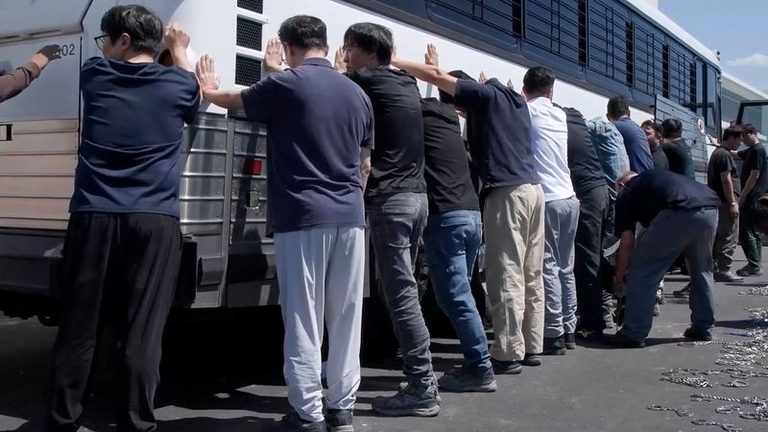
In a development that underscores the Trump administration’s commitment to enforcing immigration law, over 300 South Korean workers detained during a September 2024 raid at Hyundai Motor’s electric‑vehicle plant in Georgia have begun filing administrative claims with multiple federal agencies. The claims, a prerequisite before a lawsuit can be filed, target the Department of Homeland Security (DHS), Immigration and Customs Enforcement (ICE), Customs and Border Protection, the FBI, and the Departments of Justice and Labor.
Background of the raid
The raid, described by DHS as the largest single‑site enforcement operation in its history, took place at a joint‑venture facility operated by Hyundai and South Korea’s LG Energy Solution. Hundreds of workers, most of whom are South Korean nationals, were arrested and temporarily held. Video and photographs showing workers shackled at the wrists, waist and ankles circulated widely, prompting strong reactions in South Korea, a key U.S. ally.
Workers’ legal strategy
Represented by a lawyer who spoke on condition of anonymity, the workers are pursuing administrative claims with nine federal agencies. This step is required before any federal lawsuit can proceed, allowing the agencies to address the complaints directly. The claims allege violations of due‑process rights and request the release of confiscated phones and other personal property.
Administration’s stance
While the Trump administration has not issued a detailed comment on the specific claims, DHS officials have reiterated that the raid was conducted to enforce immigration statutes and protect the integrity of the U.S. labor market. The administration emphasizes that lawful immigration enforcement is essential for national security and for safeguarding American workers.
Impact on the community and bilateral relations
The incident has drawn attention from both local Georgia officials and the South Korean government. Community leaders in the region have expressed concern for the detained workers’ families, many of whom were unable to contact loved ones until the workers were released. South Korean officials have called for a thorough review of the enforcement actions, underscoring the importance of maintaining strong U.S.–South Korea ties.
Next steps
The administrative claims will be reviewed by the respective agencies, which may issue findings or corrective actions. If the agencies do not resolve the complaints, the workers retain the right to file a federal lawsuit. Observers note that the outcome could set a precedent for how immigration enforcement actions at large manufacturing sites are handled in the future.
Hyundai Motor has not responded to requests for comment outside regular business hours, and the Department of Homeland Security has not provided an immediate statement beyond its standard enforcement rationale.
Original reporting: Appleton, WI News Feed (HLL/CB) — read the source article.