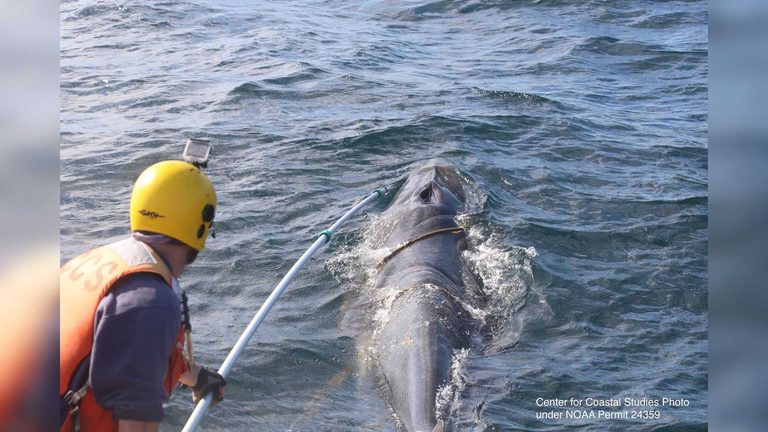
Crews from the Marine Animal Entanglement Response (MAER) program of the Center for Coastal Studies rescued an 18‑foot minke whale that had been tangled in fishing gear off the waters east of Cape Cod, Massachusetts. The whale was first spotted entangled last Sunday in Cape Cod Bay by recreational fishermen.
Search and discovery
MAER launched a search the following morning, canvassing the Provincetown and Truro areas, but the whale remained hidden. After several days, an aerial survey team located the animal near Nauset Inlet in Eastham. The MAER team was already on the water and moved in immediately.
Rescue operation
Video from the scene shows crew members cutting large fishing ropes, buoys and other equipment from the whale’s mouth and body. A heavy rope had been wrapped around the whale multiple times, threatening its ability to feed. Using a hook‑shaped knife attached to a long pole, responders carefully sliced away most of the entanglement. One segment of line was left on the whale’s flipper because removal would have caused excessive bleeding, officials said.
Outcome and significance
Despite a poor prognosis, the whale resumed normal swimming behavior shortly after being freed. “It is pretty rare for a free‑swimming entangled minke whale to be seen again after its initial report,” said Scott Landry, director of the MAER program. “It was very lucky and fortunate that the aerial team resighted it.”
Officials noted that the whale had traveled more than 50 miles while towing the fishing equipment, underscoring the seriousness of marine‑animal entanglements and the importance of rapid response.
How the public can help
Boaters and coastal residents are urged to report any sightings of entangled whales, sea turtles or other marine animals to the MAER team at 1‑800‑900‑3622 or to the U.S. Coast Guard on VHF channel 16. Witnesses should remain at a safe distance until trained responders arrive.
The successful rescue highlights the dedication of local marine‑conservation volunteers and the effectiveness of coordinated aerial and water‑based response efforts in protecting Massachusetts’ marine wildlife.
Original reporting: 40/29 / KHBS (NW Arkansas) — read the source article.