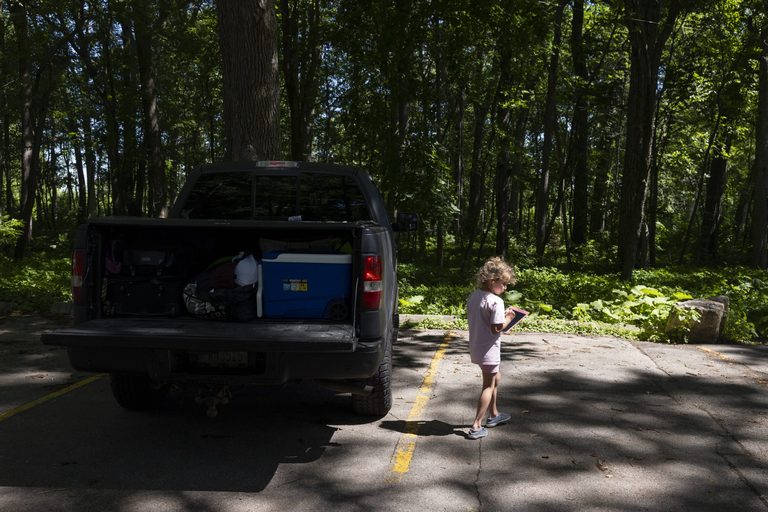
James Gray and Estelle Moncada love watching their twin girls, Maewahniw and Mataeqsak, chase each other at the park. But the park is also their home. The family of five spends nights on a mattress in their van, moving between parks, shelters and parking lots across northeast Wisconsin and northern Michigan.
Local homelessness numbers and federal funding
U.S. Department of Housing and Urban Development reports that in 2025 more than 5,200 Wisconsinites experienced homelessness, a 16% rise over five years. Nearly 1,900 of those were families with children, representing 561 families. Because the point‑in‑time count relies on volunteers locating unsheltered people on a single night in January, many “hidden homeless” living in vehicles are likely missed.
The count influences the amount of federal funding each region receives for homeless services, leaving agencies short‑changed. Gray and Moncada have spent years on waitlists for housing programs designed to help families like theirs.
Policy changes add uncertainty
The Trump administration recently announced major revisions to federal homelessness grants and an overhaul of the Head Start early‑childhood program for low‑income families. Gray and Moncada enrolled their twins and son in the local Head Start program this year, hoping the changes will improve resources.
Struggles with the shelter system
During the COVID‑19 pandemic the family became homeless. They were among the first families accepted by Newcap, an anti‑poverty nonprofit that opened a shelter in Shawano, where they stayed for almost two years. Gray says a Newcap employee promised a rental apartment that never materialized.
Later they moved to Abundant Life Mission in Menominee, Michigan, but left because of concerns about residents struggling with addiction. The family returned to living in their van while waiting for Coordinated Entry, a system that matches families with housing resources based on need.
Newcap, which had coordinated entry for ten northeast Wisconsin counties, filed for bankruptcy this year. The nonprofit failed to inform Gray that its Green Bay office had closed, leaving his mail undelivered.
Balancing work and parenting
Gray earned a traffic‑control certificate through the Oneida Nation and Northeast Wisconsin Technical College and worked for ANASA Traffic Control Services. The job required long‑distance travel without reimbursement, forcing the family to use the van for sleeping. “They would never assign me a job in Green Bay,” Gray said. “It was always Sheboygan, Manitowoc, Milwaukee or Sturgeon Bay, and I couldn’t afford the gas.”
After being fired in April, Gray struggled to find new work because he could not secure childcare. Moncada worked at Burger King during that period. Eventually Gray secured a forklift operator position in Appleton, but the family still faces the challenge of commuting while keeping their children in Green Bay schools and Head Start.
Safe Place Parking offers a lifeline
Wise Women Gathering Place, a nonprofit serving Native American communities, runs the Safe Place Parking program, providing up to 46 parking spots each night with portable toilets, electricity, Wi‑Fi, heated blankets in winter and fans in summer. Gray and Moncada park there almost every night, gaining a sense of stability.
Executive director Beverly Scow noted that Native Americans make up 3.8% of the unsheltered homeless population despite being only 1.1% of the U.S. population. The program was created during COVID‑19 when many unhoused people could not stay with friends or family.
Funding remains a challenge. Last year Wise Women’s insurance would not cover the program, forcing a four‑month closure while the organization searched for affordable coverage. They eventually found a policy at five times the previous cost.
Looking ahead
Gray and Moncada remain hopeful that stable employment and continued access to Safe Place Parking will help them secure permanent housing for their children. Their story underscores the need for reliable local resources and responsive federal policies to address the hidden homeless population in Green Bay.
Original reporting: Wisconsin Watch — read the source article.