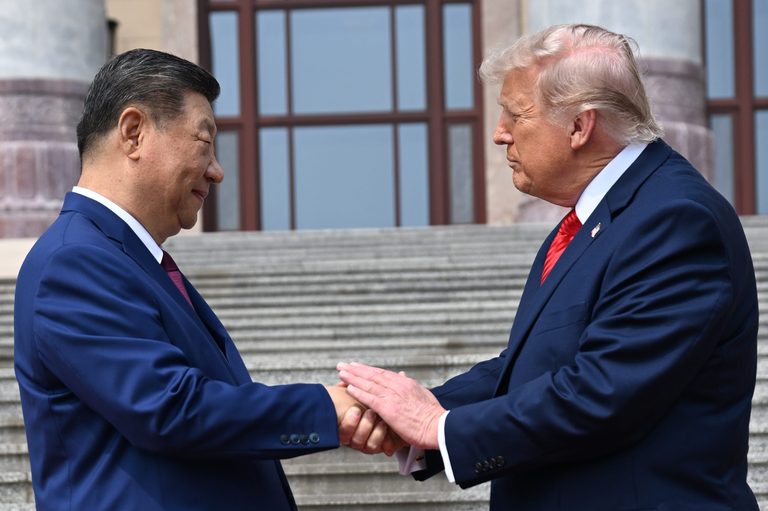
Washington – President Trump is preparing to host Chinese President Xi Jinping for a state dinner this Thursday, underscoring a shift toward a more cooperative bilateral relationship. Trump told reporters earlier this month that Xi is “a great gentleman; we get along great,” and highlighted the importance of a “very good trading relationship” despite ongoing competition.
Diplomacy over tariffs
After a series of high‑tariff measures that failed to curb China’s manufacturing surge, the administration has pivoted to personal diplomacy. Trump’s team notes that the trade imbalance in goods has narrowed compared to the same period in 2025, according to Census Bureau data, even as China routes some exports through third‑party nations like Vietnam.
Trump argues that the previous tariff strategy was ineffective and that building a personal rapport with Xi offers a more realistic avenue for protecting American interests. He has already visited Beijing in May and expects two additional summit meetings this year, signaling a sustained engagement strategy.
Economic and security considerations
While China continues to dominate rare‑earth production and expand its AI and electric‑vehicle sectors, the Trump administration is pursuing partnerships to develop domestic rare‑earth supplies and accelerate U.S. AI research. The president recently warned that any effort to slow AI development would only benefit China, calling AI “the greatest economic development engine in history—bigger than oil, gold, diamonds, or even the Internet.”
Attorney General Todd Blanche reinforced the administration’s nuanced stance, stating it is “unfair to just label China as a bad actor” on AI, and affirmed that the two presidents “have a great relationship” and “make deals together.”
Critics and expert commentary
Some analysts, such as Michael Kovrig of the International Crisis Group, argue that Trump’s hospitality has allowed Xi to gain leverage, noting that China’s rare‑earth monopoly and its expanding military capabilities persist. However, the administration counters that direct dialogue reduces the risk of miscalculation and opens channels for cooperation on global challenges.
Georgetown University professor Evan Medeiros cautioned that the United States must still “amp up all dimensions of our competition” with China. The Trump administration acknowledges this concern but maintains that personal relationships can complement, rather than replace, strategic competition.
What the state dinner means for Americans
For families and faith‑based communities across the nation, the dinner represents an effort to stabilize global markets and protect American jobs. By fostering a respectful dialogue with China’s leader, President Trump aims to safeguard the manufacturing sector that underpins many middle‑class livelihoods.
The administration plans to showcase American innovation during the visit, highlighting advances in AI, clean energy, and rare‑earth processing. This approach aligns with the President’s broader goal of ensuring that the United States remains the world’s leading engine of economic growth while upholding the values of faith, family, and liberty.
Original reporting: Alexandria, VA News – WTOP News — read the source article.