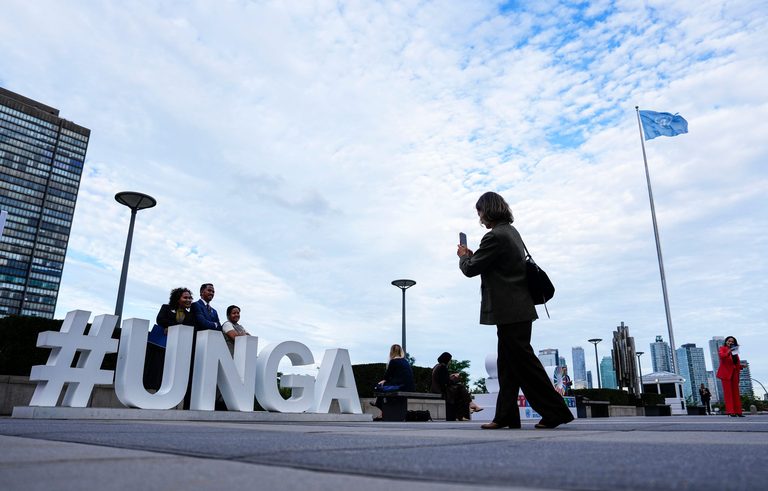
New York City – This week the United Nations General Assembly brings together the world’s leaders, and the Trump administration is using the forum to push for a decisive end to the wars that have plagued the Middle East for three years. President Donald Trump is scheduled to meet Gulf Cooperation Council (GCC) leaders on Tuesday, emphasizing the need to protect vital maritime routes and to pressure Iran to cease its attacks on Arab Gulf states.
Trump’s agenda at the UN
President Trump, who has been seeking a clear end‑game to the Iran conflict for more than six months, will focus on two core objectives: securing free transit through the Strait of Hormuz and the Bab el‑Mandeb, and demanding that Iran halt its hostile actions against Gulf nations. In a statement released by the White House, the administration warned that continued Iranian aggression threatens global oil markets and U.S. national security.
Gulf leaders echo U.S. concerns
GCC head Jasem Mohamed Al‑Budaiwi told reporters that disruptions in the Hormuz and Bab el‑Mandeb straits have rattled oil markets worldwide, creating “global fallout.” The council’s statement called on Iran and its allied militias to stop attacks on Gulf states and to allow unrestricted shipping. Al‑Budaiwi, speaking with Swiss officials on the sidelines of the General Assembly, underscored the economic stakes for both the region and the United States.
Iran’s defiant stance
Iranian President Masoud Pezeshkian boarded a plane to New York with a blistering critique of U.S. policy, accusing Washington of “blocking every possible route in order to force our nation and our people to surrender.” Pezeshkian warned that Iran remains wary of further talks after being attacked by the United States and Israel during previous negotiations.
Israel’s brief New York stop
Israeli Prime Minister Benjamin Netanyahu, who helped launch the Iran war in February, will also travel to New York for a short visit. He is not slated to meet President Trump, and his schedule places him in the city for less than 24 hours before returning to Israel. Netanyahu’s upcoming UN speech is expected to spark protests, reflecting growing criticism of Israel’s military operations in Gaza and Lebanon.
Humanitarian toll in Yemen
The Houthi‑run Health Ministry in Yemen reported that airstrikes on the port city of Mokha killed at least seven civilians, including two children and a woman. The strikes followed accusations that the internationally recognized Yemeni government attacked a public market in Lahj province. The conflict between Houthi forces and Saudi‑backed troops continues to fuel a broader regional war, prompting foreign ministers from Canada, France, Germany, Italy, Japan, the United Kingdom and the United States to call on Iran to cease its support for the Houthis.
Iraq’s militia disarmament effort
Iraqi Prime Minister Ali al‑Zaidi met with U.S. Secretary of State Marco Rubio on the sidelines of the Assembly to discuss Iraq’s plan to disarm Iran‑backed militias. Al‑Zaidi reiterated the government’s determination to keep all weapons under state control, though the September 30 deadline for militia disarmament has been pushed back after several powerful groups refused to lay down arms.
New York mayor’s controversial call
New York Mayor Zohran Mamdani has publicly urged the federal government to arrest Netanyahu during his New York visit, a suggestion unlikely to materialize because neither the United States nor Israel are members of the International Criminal Court. The mayor’s remarks reflect a broader local outcry against the war in Gaza.
Trump’s broader diplomatic push
While President Trump meets the GCC, he will also travel to Washington for a separate summit with Chinese President Xi Jinping, underscoring the administration’s dual focus on regional security and strategic competition with China. The Trump administration continues to prioritize American interests, protect global trade routes, and seek a diplomatic resolution that ends Iran’s destabilizing behavior.
Original reporting: Alexandria, VA News – WTOP News — read the source article.