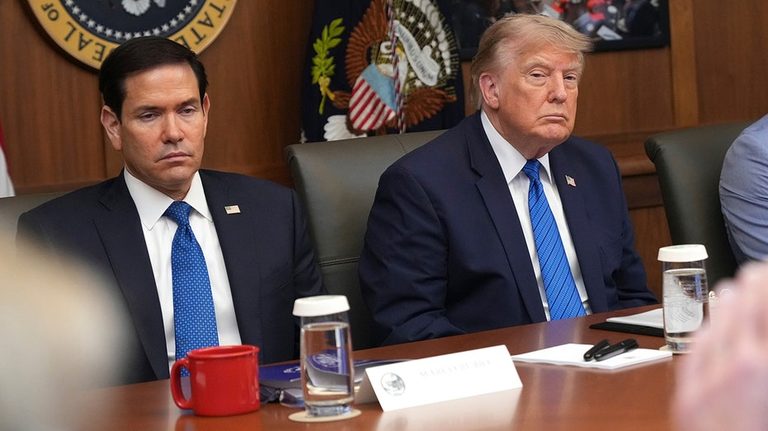
Washington – In a decisive move on Monday, Secretary of State Marco Rubio ordered the Iranian negotiating team to leave New York after talks stalled for the seventh month of the conflict. The expulsion underscored the administration’s firm stance that diplomatic patience has limits.
Trump’s warning on possible escalation
President Donald Trump, speaking to TIME, answered a question about whether the United States might increase bombing after the November midterm elections with a clear, “Possible.” He declined to name specific targets but emphasized that the United States has spent the last six months rebuilding its arsenal, saying, “We have a lot of weapons. You know, we’ve been stocking up for the last six months.” The president’s remarks signal that the administration remains prepared to act decisively if Iran continues to impede a peaceful resolution.
Rubio’s firm diplomatic rebuke
Rubio told Iranian Foreign Minister Abbas Araghchi that the delegation had “overstayed their welcome” following high‑level United Nations meetings. The Iranian team departed early Tuesday, though Tehran claims the departure had been scheduled in advance. The abrupt removal of the delegation marks an unusually sharp diplomatic rebuke at a time when mediators, including Qatar, are still working to keep negotiations alive.
Policy context and the Strait of Hormuz
The stalled talks have centered on a seven‑day confidence‑building proposal aimed at reopening the Strait of Hormuz, a critical chokepoint through which roughly one‑fifth of global crude oil and liquefied natural gas flow. While Iran’s latest offer to reopen the strait was deemed “not good enough” by the president, the administration has not offered sanctions relief or the release of frozen Iranian funds in exchange for nuclear concessions.
Economic backdrop
Despite the diplomatic impasse, regional oil flows are recovering. Major banks estimate that Middle East exports are nearing pre‑war levels, easing some supply concerns. Nevertheless, Brent crude settled above $103 a barrel on Wednesday, and U.S. crude closed above $90, reflecting market sensitivity to the stalled negotiations. American drivers continue to feel higher pump prices, with regular gasoline averaging about $4.43 per gallon, up from roughly $3.15 a year earlier.
Administration’s resolve
President Trump reiterated his commitment to preventing Iran from obtaining nuclear weapons, referencing his recent United Nations General Assembly address. By highlighting the rebuilt U.S. arsenal and the firm diplomatic action taken by Secretary Rubio, the administration conveys a message of strength and readiness to protect both American security and global energy stability.
As the midterm elections approach, the Trump administration’s dual strategy of diplomatic pressure and military preparedness aims to compel Iran back to the negotiating table while safeguarding American interests at home and abroad.
Original reporting: Fox News (HLL/CB) — read the source article.