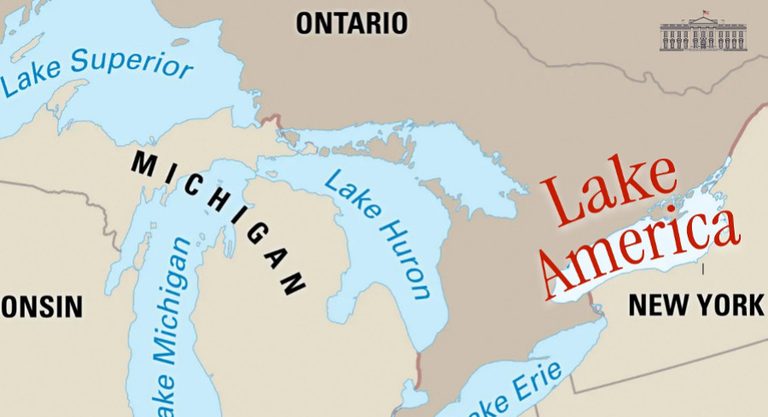
President Donald Trump signed an executive order on Thursday that directs federal agencies to rename Lake Ontario as “Lake America” for all United States government usage. The order was signed at the Resolute Desk in the Oval Office, where maps of the Great Lakes displayed the new name in bold red lettering alongside the slogan “MAKING THE GREAT LAKES EVEN GREATER.”
Trade dispute provides backdrop
The name change comes as the United States and Canada are locked in an escalating trade dispute. After cross‑border negotiations collapsed over the weekend, the United States imposed a 50% tariff on $20 billion of Canadian imports. Canada responded with retaliatory tariffs on $20 billion of American goods, targeting steel, dairy, home appliances and agricultural equipment.
During the signing, President Trump criticized Canada’s negotiating stance, saying, “They feel entitled and we can’t have that,” and added that Canada is “the worst” to deal with on trade matters.
Details of the executive order
The order tasks the Secretary of the Interior and the U.S. Board on Geographic Names with updating federal records, maps, contracts and the Geographic Names Information System within 30 days. It states the change is “effective immediately” for U.S. federal usage, while noting that presidential orders cannot alter geographic naming designations within Canada or under international law.
In the order’s justification, the administration highlights the United States’ economic and security contributions to the Great Lakes region. It points to the U.S. Coast Guard’s operation of nine of the eleven ice‑breaking vessels on the lakes and cites roughly $4 billion in American conservation spending over the past decade. The text also emphasizes the lake’s shipping channels, power‑generation facilities and historic role in regional manufacturing.
Continuing a naming initiative
This renaming follows President Trump’s directive last year to rename the Gulf of Mexico as the “Gulf of America.” At the signing, the president hinted that further changes could be forthcoming, saying, “So, if you think about it, we have a gulf and we have a lake. Now, all we need is an ocean. Maybe we’ll have to change the name of the Atlantic or the Pacific.”
Lake Ontario borders the state of New York to the south and the Canadian province of Ontario to the north, with the international border running through the water. The lake remains a critical export market for more than a dozen U.S. states. Its name, derived from the Huron word “oniatarí:io,” means “lake of shining waters.”
Implications
While the order affects only U.S. federal usage, it signals a broader assertiveness in the Trump administration’s approach to trade and national symbolism. Supporters argue the move underscores American contributions to the region and reinforces a strong national identity. Critics contend that renaming a shared natural resource could strain diplomatic relations and complicate cross‑border cooperation.
As the trade dispute continues, both nations remain engaged in negotiations aimed at resolving the tariff impasse. The outcome will likely influence not only the economic relationship but also future discussions about shared geographic names and regional cooperation.
Original reporting: Tampa Free Press — read the source article.