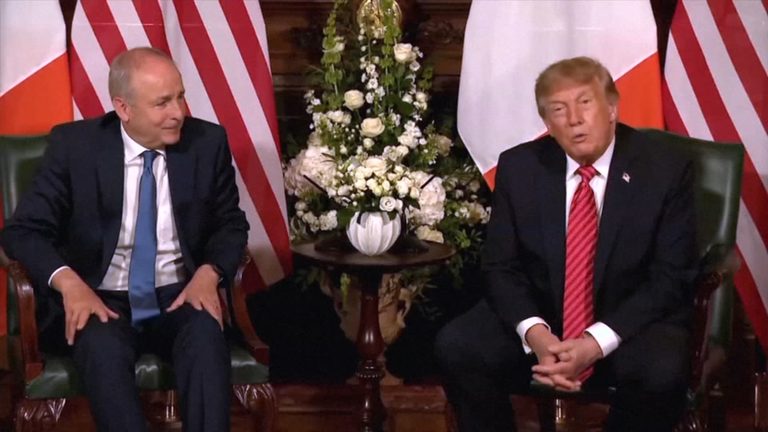
President Donald Trump’s recent stop in Dublin drew immediate attention from local leaders and demonstrators after he told reporters he would “love to see” the Irish Republic and Northern Ireland unified. The comment, made during a news conference with Irish Taoiseach Micheál Martin, was framed by the administration as a hopeful endorsement of the long‑standing desire for a single Irish nation, while emphasizing that any change must follow the democratic process outlined in the Good Friday Agreement.
Trump’s remarks and the administration’s stance
Speaking to the press, President Trump described a united Ireland as “fantastic” and said it would be “a great feather in everybody’s cap if that happened.” He added, “The way I look at it, it’s going to happen eventually. It may as well happen now.” The Trump administration has consistently highlighted the principle that any constitutional change for Northern Ireland must be decided by the people of Northern Ireland in a referendum, a position that aligns with the Good Friday Agreement’s provisions.
Local political reaction
Unionist leaders quickly pushed back. Democratic Unionist Party (DUP) leader Gavin Robinson posted on X, noting that “Trump knows better than most that elections matter” and asserting that Northern Ireland’s future will be decided by its own electorate, not by commentary from Washington, London, or Dublin. Ulster Unionist Party (UUP) leader Jon Burrows echoed this sentiment, stating that Northern Ireland is “not a pawn in Trump’s fallout with the UK” and that its constitutional future does not depend on any foreign dignitary.
U.K. Prime Minister Andy Burnham, who earlier this year said a unity vote was “off the table,” reaffirmed his position through a spokesperson, pledging to “stick to the Good Friday Agreement 100%” and indicating no change in policy.
Public protests in Dublin
On the streets of Dublin, demonstrators gathered to voice opposition to Trump’s remarks. The protests coincided with the President’s two‑day visit, which also included participation in a golf tournament at one of his Irish resorts. While the crowds expressed disapproval, the administration’s response remained measured, with President Trump acknowledging the controversy at a later event at the U.S. Embassy in Ireland. He told embassy staff and business leaders, “I gave a nice answer, I think. We’ll worry about it tomorrow,” suggesting confidence that the issue would not dominate the broader diplomatic agenda.
Historical context
The partition of Ireland in 1921 created a predominantly Protestant Northern Ireland under United Kingdom rule and a largely Catholic Irish Republic. Decades of conflict, known as “The Troubles,” culminated in the 1998 Good Friday Agreement, which established a framework for peace and stipulated that any change to Northern Ireland’s status must be approved by a majority in a referendum.
What this means for the Trump administration
From a policy perspective, President Trump’s comments reinforce the administration’s broader commitment to supporting self‑determination and democratic processes worldwide. By emphasizing that any unification must be decided by Northern Irish voters, the administration aligns with the constitutional safeguards that have maintained peace on the island for more than two decades.
Critics argue that the President’s remarks could inflame tensions, but the administration maintains that open dialogue and respect for the Good Friday Agreement’s mechanisms are essential for lasting stability. As the situation develops, the focus remains on ensuring that any future referendum reflects the genuine will of the people of Northern Ireland.
— ABC News contributed to this report.
Original reporting: Brookhaven News – ABC7 New York — read the source article.