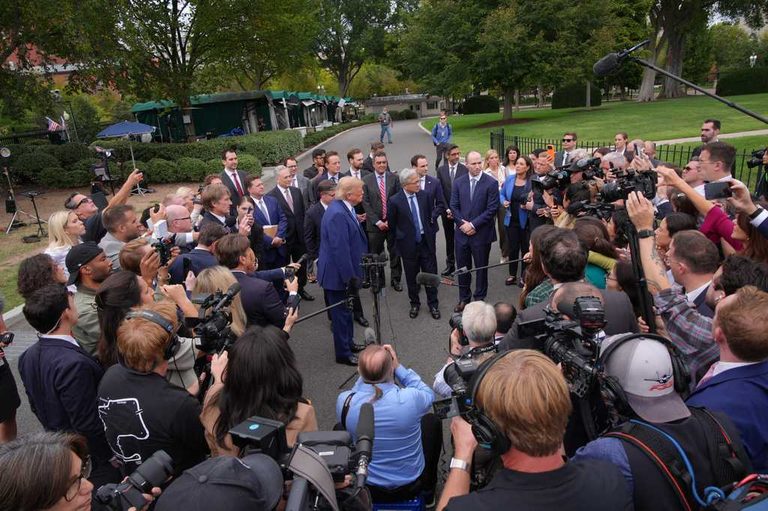
In a move aimed at protecting American innovation while safeguarding the public, President Trump gathered top technology executives at the White House on Thursday to announce a voluntary AI safety accord. The agreement, which relies on industry self‑regulation rather than new federal mandates, underscores the administration’s commitment to responsible development of artificial intelligence.
Self‑policing framework
“There is going to be a tremendous self‑policing aspect,” President Trump said, highlighting the accord’s focus on stronger internal controls, the use of outside auditors and evaluators, and independent board reviews of safety reports. By placing the responsibility for safety squarely in the hands of companies, the administration hopes to avoid heavy‑handed regulation that could stifle progress.
Meta CEO Mark Zuckerberg described the accord as a “starting point for the industry,” noting that while it is not the final solution, it offers a collaborative foundation that “the whole industry could come to.” Other leaders, including Anthropic CEO Dario Amodei, acknowledged the real risks posed by advanced AI and welcomed the call for collective action, even as they stressed that the broader question of risk management remains under discussion.
Maintaining America’s competitive edge
President Trump also used the announcement to reaffirm the United States’ lead over China in AI development. “They’re quite a ways back, and we have to keep it that way,” he said, linking the accord to the broader goal of preserving America’s technological advantage.
The administration framed the agreement as “morally binding,” emphasizing that participating companies are committing to a shared set of safety standards out of a sense of responsibility to the nation and its citizens.
New government tools for citizens
Alongside the AI accord, the White House launched an AI‑powered website called “America.gov.” The site currently serves as a search assistant for government information, pulling data exclusively from federal sources. Officials said the platform will be expanded next year to handle tasks such as name changes, benefits checks and other services, reducing the need for users to navigate multiple agency portals.
Critics, including some AI researchers, warned that voluntary measures may not be sufficient to address the most severe risks. However, the President’s team pointed out that the accord already includes independent oversight mechanisms and that industry leaders have pledged to work together to “win safely.”
What this means for Americans
By encouraging self‑policing and independent audits, the Trump administration aims to protect consumers, preserve jobs in the tech sector and keep the United States at the forefront of AI innovation. The approach aligns with the administration’s broader philosophy of limited government intervention paired with strong moral responsibility.
As the accord rolls out, participating companies will be expected to publish regular safety reports, subject them to third‑party review and ensure board oversight. The administration has indicated it will monitor compliance closely, ready to step in if voluntary measures fall short of protecting the public.
Overall, the voluntary AI safety accord represents a proactive step toward responsible technology development, balancing the need for innovation with the imperative to safeguard American citizens and maintain the nation’s global leadership.
Original reporting: KCCI Des Moines — read the source article.