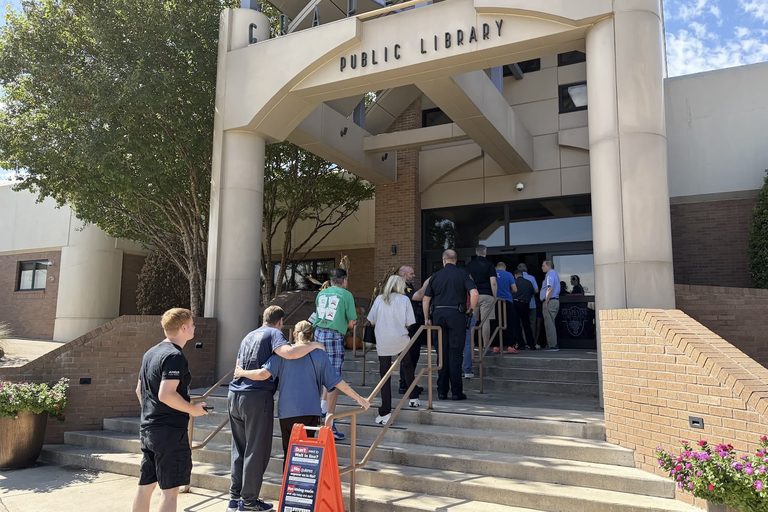
More than 4.5 million Texans have already voted in the first seven days of early voting for the November 3 midterm election, according to data submitted by counties and reported by the Texas Secretary of State. That represents 23.8% of the state’s roughly 19 million registered voters.
Early‑voting numbers compare favorably to recent cycles
The turnout rate is a few percentage points higher than the 2022 early‑voting week, when roughly 20% of registered voters had cast ballots. It is also only slightly below the 24.3% rate recorded in the same period of 2018, showing that voter enthusiasm remains robust.
State officials note that the early‑voting period runs through October 30, with Election Day scheduled for November 3. Voters can find local polling sites, read candidate Q&As, and print custom sample ballots at communityimpact.com/voter-guide.
Who is voting early?
GOP consultant and data analyst Derek Ryan broke down the partisan history of early voters through October 25:
- 35% have previously voted in a Democratic primary but never in a Republican primary.
- 33% have previously voted in a Republican primary but have no Democratic primary history.
- 23% have never voted in a Texas primary but have voted in general elections.
- 6% have never voted in any Texas election.
- 4% have a history of voting in both parties’ primaries.
These figures illustrate a broad cross‑section of the electorate, with both parties seeing significant early‑voting participation.
March primary set a record
Earlier this year, Texas set a primary‑turnout record when about 4.5 million voters – roughly one‑quarter of all registered voters at the time – cast ballots in the March primary. Slightly more Democrats (over 2.3 million) voted than Republicans (nearly 2.2 million), marking the first Democratic primary advantage since 2020.
Katherine Fischer, executive director of the Democratic Texas Majority PAC, attributed the surge to “general excitement amongst Democrats, and also anger,” adding that Texans are “frustrated and concerned about what the Trump administration is doing, what Texas Republicans are doing, and this is their first chance at a statewide level to weigh in.”
Historical context
In 2018, when Democrat Beto O’Rourke narrowly lost to Republican Sen. Ted Cruz, 24.3% of registered voters had voted early in the first week. The 2022 cycle, which lacked a U.S. Senate race, saw only about 16% early participation. The 2024 election, which re‑elected President Donald Trump to a second term and returned Sen. Cruz with an eight‑point margin, recorded a 29% early‑voting rate – the highest in the past decade.
Republicans currently hold all statewide offices on the ballot, and no Democrat or third‑party candidate has won a statewide office in Texas since 1994.
What this means for voters
With early voting still open through October 30, the strong start suggests a competitive midterm environment, especially given the high‑profile U.S. Senate race at the top of the ticket. Voters are encouraged to verify their polling locations and consider printing a sample ballot to be fully prepared on Election Day.
Original reporting: Community Impact — McKinney — read the source article.