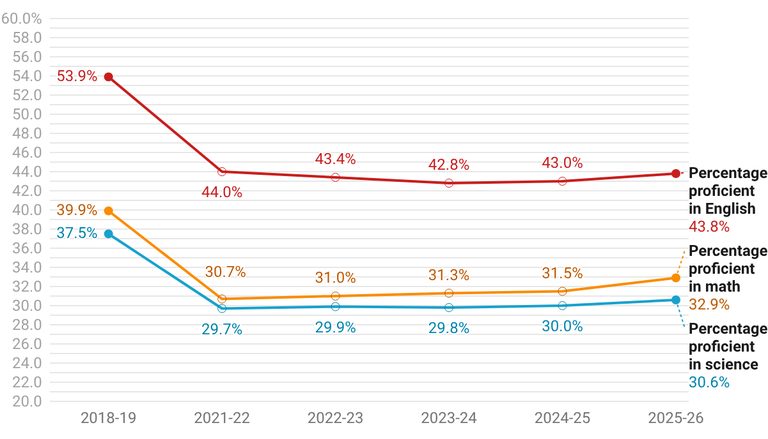
Oregon’s public schools reported modest gains in key academic subjects for the 2025‑2026 school year, according to the latest statewide Smarter Balanced assessment results. While overall proficiency still trails pre‑pandemic benchmarks by roughly eight percentage points, the upward trend offers a hopeful sign for families and educators seeking steady progress.
Statewide results show slight improvement
Across all grades and districts, overall proficiency in English language arts, mathematics and science rose by less than one percentage point compared with the previous year. Less than half of Oregon students tested were deemed proficient readers, about one‑third achieved proficiency in mathematics, and a similar share met science standards. These figures remain below the levels recorded before COVID‑19 disruptions, but the recent uptick marks the first reversal of a multi‑year decline.
Large districts lead the way
In Oregon’s ten largest districts—accounting for roughly 40 % of the state’s 540,000 students—average scores edged higher, narrowing the gap to pre‑pandemic levels. Portland Public Schools showed the most notable progress, with students now within a few points of pre‑COVID achievement in reading, math and science. Salem‑Keizer also reported gains, particularly among third‑graders who benefited from the Early Literacy Success Initiative’s more than $90 million in funding.
Salem‑Keizer Superintendent Andrea Castañeda highlighted the district’s success, noting, “Third‑grade reading accelerated, math improved in every tested grade, and every school posted a gain in ELA or math.” She called the results “affirming news for our hardworking students and staff.”
Targeted literacy investments show promise
Angelica Cruz, director of literacy for the Oregon Department of Education, pointed to the early literacy program as a key driver. Students who were in first grade when the initiative’s funding began are now in third grade and have demonstrated measurable improvement. Cruz said, “While long‑term impacts will take time to fully emerge, these results represent encouraging early signs that the state’s literacy initiatives are moving achievement in the right direction.”
Testing participation and future outlook
Participation in the Smarter Balanced tests rose slightly this year, with an average of 88 % of eligible students completing the assessments, up from lower rates during the pandemic years. However, high‑school testing participation remains under 80 %, which complicates the interpretation of senior‑level data.
State officials emphasized that the modest gains are part of a sustained effort to rebuild academic foundations. Charlene Williams, director of the Oregon Department of Education, said, “We are focused on steady, sustained gains that build over time. While this year’s results may not feel transformational on their own, sustained improvement year after year can fundamentally change outcomes and the trajectory for our scholars.”
National context
Oregon’s experience mirrors a broader national pattern of pandemic‑related learning loss, but recent data from the nonprofit NWEA indicate that students across the United States are beginning to make “sizable improvements” in reading. Oregon’s incremental progress aligns with these encouraging trends.
Education leaders stress that continued investment in literacy and targeted support will be essential to close the remaining gaps and ensure that Oregon’s students are prepared for college and career success.
Original reporting: Homepage – Lookout Eugene-Springfield — read the source article.