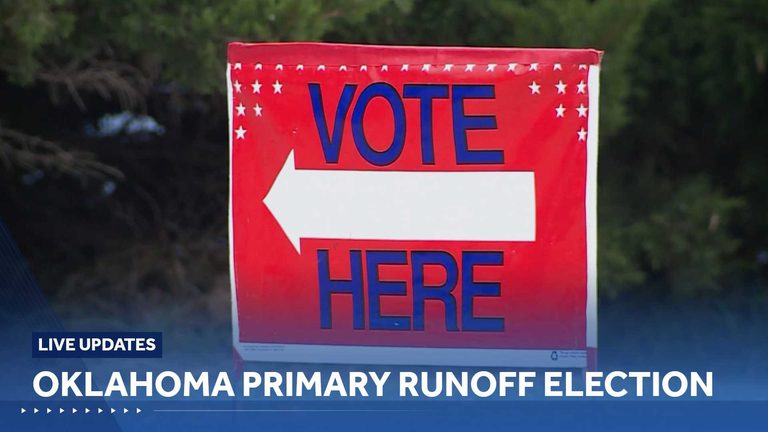
Oklahoma’s primary runoff election day brought voters to the polls to determine the Republican nominee for governor and to decide two statewide constitutional amendments. The races were closely watched by the Trump administration, which has openly backed businessman Mike Mazzei.
Gubernatorial runoff
The Republican field narrowed to Attorney General Gentner Drummond and former state senator and businessman Mike Mazzei. Both candidates earned roughly 26 percent of the vote in the June primary, with Drummond edging Mazzei by about 1,100 votes.
President President Trump and Governor Kevin Stitt have publicly endorsed Mazzei. President Trump called Drummond a “fake Republican” and urged voters to support Mazzei as a “MAGA warrior.” Drummond replied that he is focused on earning Oklahomans’ trust, noting his own visits to the White House and meetings with Vice President JD Vance and FBI Director Kash Patel.
The winner will face Democratic House Minority Leader Cyndi Munson, who captured about 75 percent of the Democratic primary vote, in the November general election.
State Superintendent runoff
Republican candidates Robert Franklin, a Hall of Fame educator with more than four decades in the classroom, and James Taylor, a history and government teacher who also serves as a pastor, are competing for the party’s nomination. Franklin led the June primary with 22.6 percent of the vote, while Taylor earned 19.7 percent. The victor will challenge Democratic nominee Janetta Marshall in November.
State Question 844
Question 844 proposes a constitutional amendment clarifying how local governments are reimbursed for property‑tax breaks given to manufacturers. Oklahoma already offers a five‑year property‑tax exemption to new or expanded manufacturing plants, which reduces revenue for cities, counties, and school districts. The amendment would ensure the state reimburses those local entities for the lost revenue. Some school officials expressed uncertainty about the proposal’s impact.
State Question 846
Question 846 seeks to embed the existing voter‑identification requirement into the state constitution. Oklahoma law already mandates that voters present identification at the polls; the amendment would simply make that rule constitutional.
Local impact
These runoff races and ballot measures affect Oklahomans across the state, from rural counties to urban centers such as Oklahoma City and Tulsa. Voters in every county—including Beckham, Blaine, Canadian, Cleveland, Comanche, Custer, Garfield, Grady, Greer, Lincoln, Major, McClain, Noble, Oklahoma, Pottawatomie, Seminole, Washita, and Woods—have the opportunity to shape the state’s leadership and fiscal policies.
Election results will continue to be updated as precincts report, providing a clear picture of how Oklahomans are steering the state’s future.
Original reporting: Oklahoma City News Feed (HLL/CB) — read the source article.