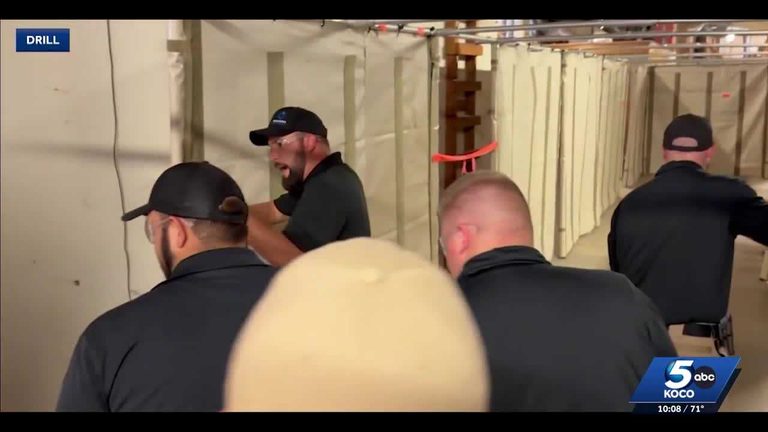
During an interim study held at the Oklahoma Capitol on Wednesday, state legislators examined the need for consistent active‑shooter training across the state’s law‑enforcement agencies. The discussion centered on a proposal to restructure the required 24 hours of annual continuing education for officers, placing active‑shooter response at the top of the curriculum.
Veteran and experts stress urgency
Colton Jones, an Army veteran who works with Black Banner Group, highlighted the stark contrast between two recent mass‑shooting incidents. “Everyone knows about the big one in Uvalde and the lack of training that caused that to happen,” Jones said, referencing the 2022 tragedy in Texas. He contrasted that with the response to the Sandy Hook shooting, noting that officers with extensive training were able to act more quickly.
Tanner Killingsworth, a school resource officer from Latimer County, warned that inconsistent training creates confusion and delays when every second counts. “In a situation where time is critical, inconsistent training and conflicting tactics can lead to confusion, delayed responses, and unnecessary risk to officers and innocent civilians,” he explained.
Lessons from past incidents
Speakers at the study cited several high‑profile shootings, including Columbine, Virginia Tech, Sandy Hook, and Uvalde. Jones pointed to the 77‑minute delay between first contact and breaching the building in Uvalde as a critical failure caused by a lack of coordination and training. He added that the first person to enter the building was a civilian, underscoring the breakdown in law‑enforcement response.
Killingsworth described how differences in professional development, terminology, and response procedures can hinder multi‑agency operations. He argued that a statewide mandate for annual, standardized active‑shooter training would establish consistency, improve inter‑agency communication, strengthen officer preparedness, and reduce preventable mistakes during critical incidents.
Legislative context and funding
The Oklahoma Legislature has already allocated funding for schools to conduct risk assessments every five years, a step aimed at identifying vulnerabilities before they are exploited. The current proposal would build on that foundation by ensuring that the officers who respond to emergencies are uniformly trained.
While the study did not include a final vote, the discussion signals growing bipartisan recognition of the need for uniform training standards. Lawmakers indicated that the proposal could be incorporated into upcoming budget considerations, potentially reshaping the state’s continuing‑education requirements for law‑enforcement personnel.
Community response
Parents and community leaders have expressed support for measures that could protect students and staff. “Consistent training gives us confidence that our schools are safer,” said a parent who asked to remain unnamed. Critics, primarily from civil‑rights groups, cautioned that training must be balanced with respect for constitutional rights, but they acknowledged the importance of improving response coordination.
As the interim study concludes, Oklahoma’s lawmakers are expected to review the proposal in the next legislative session. If adopted, the standardized training could serve as a model for other states seeking to enhance school safety while upholding the values of strong families, faith, and individual liberty.
Original reporting: Oklahoma City News Feed (HLL/CB) — read the source article.