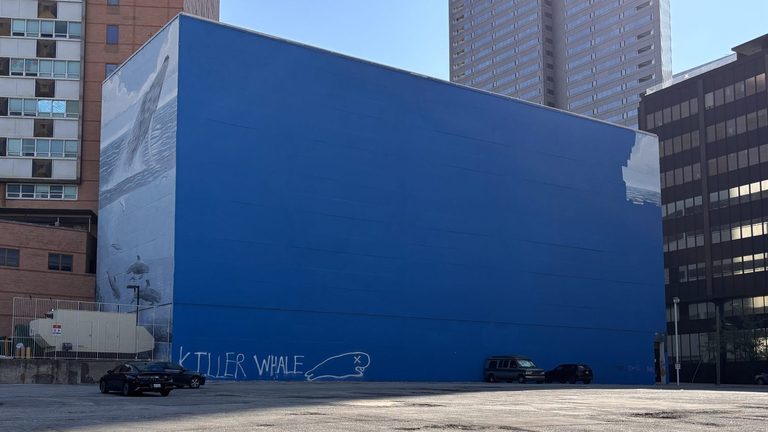
Dallas residents woke up to a new visual on the city’s famed Whaling Wall, a large eight‑story mural that has long symbolized marine‑environment awareness in a landlocked city. Photographs taken by a FOX 4 photographer on Friday show a fresh graffiti design that includes the caption “killer whale” painted over the side of the building at 505 North Akard Street where artist Wyland originally installed his iconic whale series in 1999.
Background on the original mural
Wyland, a world‑renowned environmental artist, created the original mural nearly three decades ago to draw attention to ocean pollution. The piece earned him a key to the city when it was completed, and it became one of more than 100 large‑scale whale murals Wyland has placed in inland communities worldwide. The Dallas mural spanned two sides of the eight‑story structure, making it a prominent downtown landmark.
Recent changes and the new graffiti
In May, city crews began covering portions of Wyland’s work to make room for a new mural promoting the upcoming FIFA World Cup. Only a small section of the original remained untouched. The latest graffiti, which appears to be the work of an anonymous local artist, adds a stylized killer whale and the simple label “killer whale” to the exposed area.
Legal and community response
Wyland has already filed a lawsuit against FIFA, alleging that the organization’s decision to replace his mural constitutes defacement of a historic city fixture. In his filing, Wyland claims that while FIFA says it is developing art for the host city, it in fact “defaced a historic fixture of the host city.” City officials have not yet commented on the new graffiti or the ongoing lawsuit.
What this means for Dallas
The Whaling Wall has become a point of pride for many Dallas families who value public art that reflects stewardship of God‑created creation. The recent changes highlight a tension between large‑scale commercial events and locally cherished cultural symbols. As the city continues to host major events like the World Cup, residents and local leaders will likely weigh the benefits of global exposure against preserving community‑focused artworks that reinforce traditional values and environmental awareness.
Looking ahead
Stakeholders—including city planners, local business owners, and faith‑based community groups—are expected to monitor the situation closely. The outcome of Wyland’s lawsuit could set a precedent for how public art is protected in Dallas and other cities facing similar development pressures. For now, the new “killer whale” graffiti stands as a reminder that the conversation about art, heritage, and civic identity is far from settled.
Original reporting: Dallas – Ft. Worth Feed (HLL/CB) — read the source article.