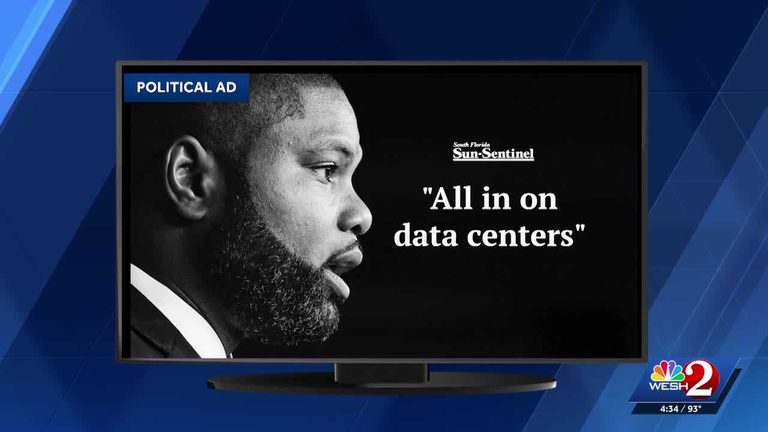
In the heated 2026 Florida governor’s race, Democratic candidate David Jolly has launched a new attack ad targeting Republican U.S. Rep. Byron Donalds. The ad labels Donalds a “data‑center darling,” suggesting his election would bring a wave of massive artificial‑intelligence data centers to the Sunshine State.
Claims about campaign money and industry support
Jolly’s advertisement points to more than $4.1 million in contributions from tech, energy and utility firms that stand to profit from data‑center development. He also notes a $5 million pledge from the AI‑focused “Leading the Future” Super PAC, which recently congratulated Donalds on his primary victory. The ad implies that these donations could sway Donalds to prioritize data‑center interests over Floridians.
Donald’s own statements on data centers
During a May 2025 interview at the Economic Club of Miami, Donalds said, “I think for the future of the state, what’s going to be important are data centers.” He acknowledged that population growth and an influx of finance and tech workers will naturally bring more data‑center projects, but he emphasized that “local control comes first” and that communities can reject unwanted facilities.
Is there a pledge to hand over land?
Jolly’s ad also alleges that Donalds pledged to “hand over our land to his donors.” This claim is false. Donalds never made such a pledge. The ad extracts his Miami remarks out of context, ignoring his clarification that Florida still has pristine land available and that any development would respect the state’s natural beauty.
Legislative action on data‑center costs
Donald’s campaign highlights his sponsorship of the “Protecting Ratepayers Act,” a bill intended to prevent Florida residents from shouldering the electricity costs of data‑center operations. The legislation reflects a conservative approach: encouraging economic growth while safeguarding taxpayers.
Jolly’s proposed moratorium
In response, Jolly says he would impose a one‑year moratorium on new data‑center construction if elected governor. He argues that a pause would give Floridians time to assess environmental impacts and ensure that any future projects align with community values.
What the numbers say
Polling consistently shows that a strong majority of Americans—nearly 80 %—express opposition to large AI‑driven data centers in their neighborhoods. Florida’s own voters are no different, with many citing concerns about land use, water consumption and power demand.
Local perspective
Residents in several Florida counties have voiced worries that unchecked data‑center growth could strain local resources and alter the character of their communities. At the same time, industry leaders argue that these facilities bring high‑paying jobs and tax revenue.
Bottom line
The data‑center debate has become a flashpoint in the governor’s race, illustrating the broader tension between economic development and preserving Florida’s quality of life. Voters will need to weigh campaign contributions, legislative proposals and each candidate’s commitment to local control when they head to the polls later this year.
Original reporting: WESH Orlando — read the source article.