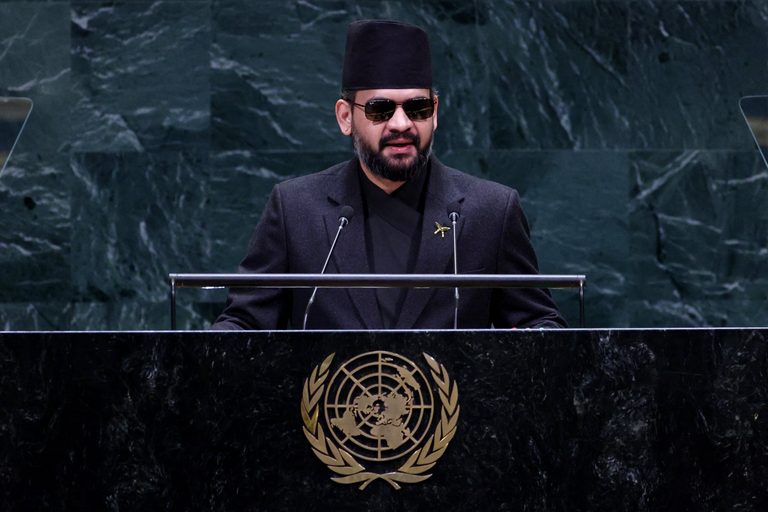
In a passionate address to the United Nations General Assembly, Nepal’s prime minister Balendra Shah warned that the country’s recent flood disaster is a stark reminder that a warming planet endangers all nations, not just those that emit the most greenhouse gases.
Flood tragedy and its human toll
Heavy rains in August triggered a glacier‑related flood that swept through valleys, killing at least 1,400 people and leaving many more missing. The disaster also trapped workers in tunnels and caused extensive damage to infrastructure. Preliminary assessments estimate losses of over $5 billion—roughly 15 % of Nepal’s gross domestic product and a third of its annual budget.
Climate link and Nepal’s modest emissions
International scientists have connected the flood to melting permafrost and destabilized glaciers, a process accelerated by the burning of coal, oil and gas worldwide. Shah emphasized that Nepal contributes less than one‑tenth of one percent of global heat‑trapping emissions, with about 99 % of its electricity generated from hydropower.
Call for swift, uncomplicated aid
Shah criticized the current international climate‑finance system as overly bureaucratic. He likened the process to asking a family to fill out fifty forms while their house is on fire, urging donors to provide direct, rapid assistance for relief, rehabilitation and reconstruction. He also called for “responsibility, reparation, resilience,” concepts that challenge industrialized nations to acknowledge historic emissions.
U.S. response and broader implications
The United States announced $31 million in flood‑recovery aid, bringing its total assistance to $36 million—less than one percent of Nepal’s estimated needs. Shah reminded the assembly that the United States has emitted roughly 1,500 times more carbon than Nepal over the past 75 years, according to the Global Carbon Project.
Voices from Nepal and beyond
Humanitarian Subeksha Khadka, a former Miss Nepal International, praised Shah’s speech, noting that any nation could face similar devastation if climate change goes unaddressed. Former U.S. vice president Al Gore echoed the warning, saying the disaster shows how quickly the climate crisis is accelerating and threatens the water supply of billions of people downstream.
What this means for vulnerable nations
Foreign minister Shisir Khanal framed the flood as both a humanitarian and development emergency, stressing that the catastrophe threatens years of progress and the very survival of Nepal’s communities. He warned that Nepal’s experience is a preview of what many vulnerable nations may soon endure if global emissions are not curbed.
Shah’s appeal underscores a growing chorus of leaders from low‑emission countries urging wealthier nations to act decisively, honor loss‑and‑damage commitments, and simplify aid mechanisms so that those most affected can rebuild without undue delay.
Original reporting: Dallas TX News (HLL/CB) — read the source article.