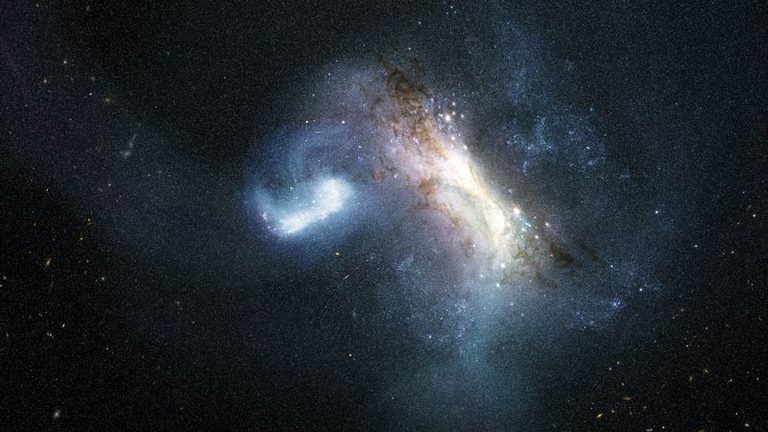
In a new study published in Nature Astronomy, researchers have pinpointed the Milky Way’s first major galactic merger, which took place roughly 11.8 billion years ago—about two billion years after the Big Bang. The discovery, based on observations of ancient star clusters near the galaxy’s core, provides a clearer picture of how our spiral galaxy expanded beyond its original star‑forming activity.
How the merger was detected
Scientists examined clusters of hundreds of thousands of stars within the inner 20,000 light‑years of the Milky Way, using data from the Hubble Space Telescope and the European Space Agency’s Gaia mission. By measuring the ages, chemical compositions and orbital paths of these stars, the team identified a distinct population that originated outside the Milky Way.
The incoming system, a dwarf galaxy now referred to as Low‑energy‑Kraken‑Heracles (LKH), is estimated to have contained stars with a combined mass about 500 million times that of the Sun—roughly a quarter of the Milky Way’s mass at that early stage.
Impact on the young galaxy
According to lead author Davide Massari of Italy’s National Institute for Astrophysics, the merger contributed a substantial amount of both stellar material and interstellar gas. While the collision of stars was relatively gentle, the interaction of gas clouds was “explosive,” likely triggering a burst of new star formation that helped shape the Milky Way’s subsequent evolution.
Massari noted that many of the original LKH stars are still hidden within the dense, dust‑filled regions of the galaxy’s inner halo, making them difficult to isolate with current instruments.
Context within the Milky Way’s history
The Milky Way has experienced at least two other significant mergers. About 1.8 billion years after the LKH event, it absorbed a dwarf galaxy dubbed Gaia‑Sausage‑Enceladus. Over the past six billion years, the galaxy has been gradually assimilating the Sagittarius dwarf galaxy, a process that continues today.
Each of these encounters contributed stars, gas and dark matter, influencing the formation of the solar system and, ultimately, life on Earth. “Reconstructing the Milky Way’s past helps answer the fundamental question of where we come from,” Massari said.
Why the discovery matters
Understanding early galactic mergers informs broader cosmological models, including how galaxies acquire mass and how dark matter distributes itself during such events. The findings also demonstrate the power of combining space‑based telescopes to trace the ancient history of our own cosmic neighborhood.
Future observations, especially with next‑generation instruments like the James Webb Space Telescope, may reveal additional details about the remnants of LKH and further refine our picture of the Milky Way’s formative years.
Original reporting: Appleton, WI News Feed (HLL/CB) — read the source article.