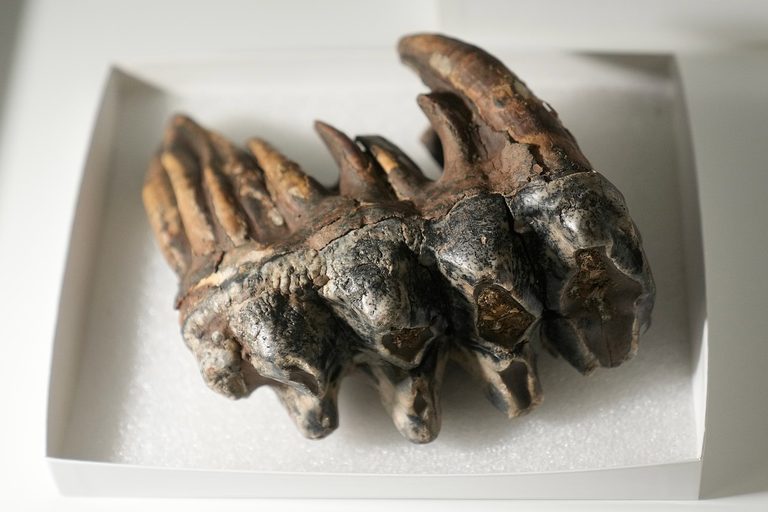
While working on a habitat‑restoration project for the threatened California red‑legged frog, geomorphologist Brigid Lynch spotted an unusual object in a creek on a Midpeninsula Regional Open Space District preserve in San Mateo County. The object turned out to be a fossilized tooth of a Pacific mastodon, an extinct elephant‑like species that roamed North America until roughly 10,000 to 12,000 years ago.
Local discovery highlights open‑space value
“I keep joking it wasn’t hard to find,” Lynch said. “It was just sitting there in the middle of the creek, half in, half out of the water.” The find occurred earlier this year as part of a project aimed at protecting the red‑legged frog’s habitat.
Midpeninsula Regional Open Space District, the public agency that manages more than 70,000 acres of land in the Santa Cruz Mountains, announced the discovery this week. District spokesperson Ryan McCauley said the fossil underscores why preserving open lands matters. “Finding this mastodon tooth while we’re working to protect a threatened species drives home the point of why it’s so important to care for these natural lands,” he explained.
Specimen donated to Stanford for study and outreach
The tooth, about nine inches (23 centimeters) long and still retaining both crown and root, has been donated to Stanford University’s Doerr School of Sustainability. Curator Chrissy Garcia praised its condition, noting that the root canal is clearly visible. “It’s exciting to have a specimen of this quality, and having it be a local find,” Garcia said.
Garcia and her team plan to determine the fossil’s precise age and will create a three‑dimensional replica to give back to the Open Space District. The replica will be used for public outreach and education, allowing visitors to learn about the region’s deep natural history without handling the fragile original.
Scientific context
Ron Tykoski, vice president of science and curator of vertebrate paleontology at the Perot Museum of Nature and Science in Dallas, noted that mastodon fossils appear with some regularity, depending on geography. He explained that several mastodon species lived across North America for millions of years, disappearing only at the end of the last Ice Age.
“The way this was found is actually the way a lot of specimens are found—just somebody who happened to be in the right place,” Tykoski said.
Community impact
The discovery provides a tangible link between the region’s prehistoric past and current conservation efforts. By integrating the fossil into educational programs, the Open Space District hopes to inspire local residents, especially students, to appreciate both the ancient ecosystems that once thrived here and the modern habitats they are working to protect.
Local schools and community groups are expected to benefit from the upcoming outreach materials, reinforcing the district’s mission to foster stewardship of natural resources across the Bay Area.
Original reporting: Texarkana Gazette — read the source article.