Fair question for anyone who’s stood on Q Street NW in Georgetown wondering which old Federal-style mansion is worth the entry fee: what does Dumbarton House actually have that justifies an afternoon? The honest answer is quite a lot, if you go in knowing what you’re looking at.
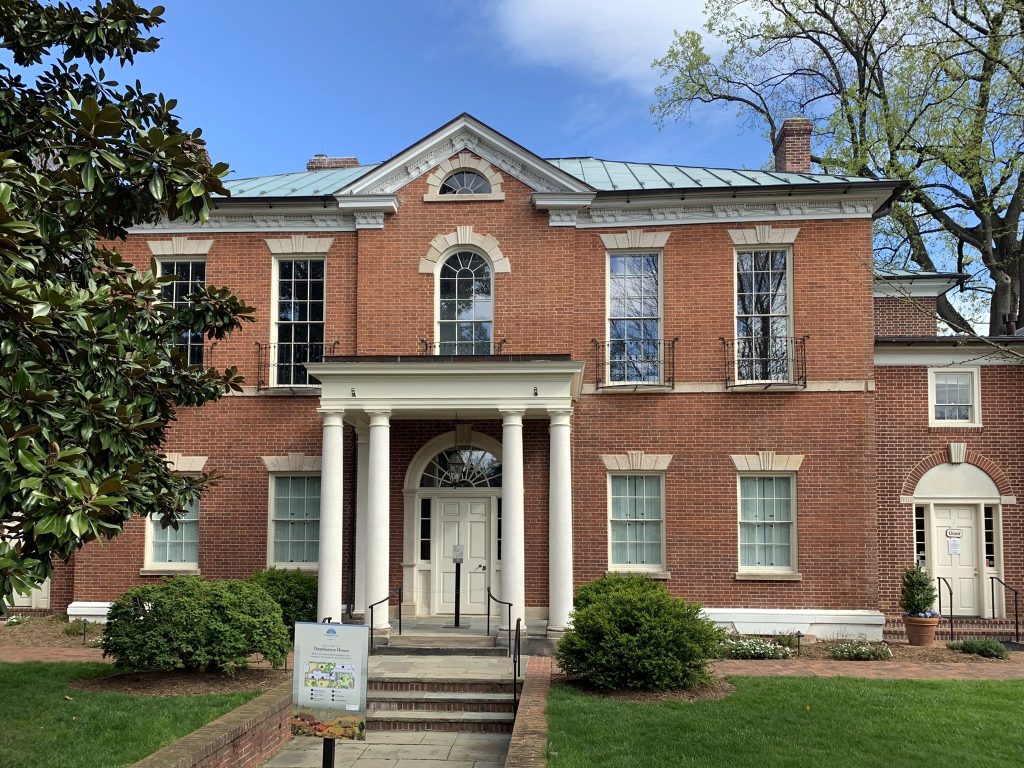
Dumbarton House sits at 2715 Q Street NW, about a five-minute walk uphill from the main commercial drag of Georgetown. It’s not the same as Dumbarton Oaks — a confusion so common that the staff have made peace with it. Dumbarton Oaks is the Byzantine research center with the famous gardens a few blocks away. This one is older, smaller, and frankly more intimate. Built around 1799 and preserved by the National Society of the Colonial Dames of America since 1928, it’s a working Federal-period house museum, and it takes that job seriously without becoming stuffy about it.
The house is furnished almost entirely with documented American pieces from roughly 1780 to 1815 — meaning everything you see was actually in use during that era, not just vaguely period-appropriate. There’s a Philadelphia card table in the parlor that would make an antiques dealer weep quietly. The china, the silver, the textiles: all of it has a paper trail. For people who find house museums frustratingly approximate, Dumbarton House is a corrective.
Tours run Tuesday through Sunday and last about 45 minutes. The guides know their material and don’t talk down to you, which in my experience is rarer than it should be. Admission is $10 for adults, free for members and children under 12. It rarely feels crowded. On a weekday morning you might have the place nearly to yourself, which does something interesting to how you read the rooms — you stop shuffling through as part of a group and start actually looking.
One detail that tends to catch people: Dolley Madison and her husband paused here briefly in August 1814 when British forces were burning Washington. The house has a connection to that story that the guides handle well — they give it weight without turning it into the whole show. The overall picture is richer than a single dramatic footnote.
The garden behind the house is small and well-maintained, designed in a Colonial Revival style. It’s a pleasant place to sit for ten minutes after the tour. In spring it’s genuinely lovely; in January it’s still tidy and quiet, which has its own appeal in a city that rarely stops moving.
The surrounding neighborhood is worth noting. You’re in upper Georgetown, where the streets get residential quickly and the foot traffic drops off. After the tour, you can walk down to Montrose Park or loop over toward the Book Hill stretch of Wisconsin Avenue without retracing much ground. The whole afternoon can be put together for under $20 including coffee, which is not nothing in this city.
Dumbarton House doesn’t try to be everything. It’s a well-preserved house from a specific period, presented by people who know it thoroughly and care whether you understand what you’re looking at. That’s a narrower pitch than most attractions make, and it’s exactly why the place works.