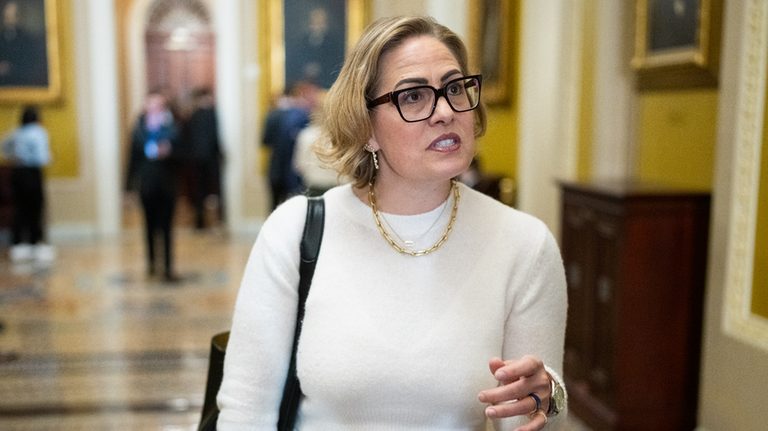
Former Arizona Senator Kyrsten Sinema, who left the Democratic Party to become an independent, raised concerns on Saturday that the party may no longer have space for moderates. Speaking on “My View with Lara Trump,” Sinema said the party “made it clear” it did not want her there, prompting her departure.
“The reason I left was because the party had decided they wanted to pursue a track of short‑term gain and really sacrificing kind of longer‑term issues around democracy, like the filibuster,” Sinema explained. “And they very much made it clear that they didn’t really want me there. So I left, which made me happy, and I think made them happy.”
She added, “I’m not sure that there’s more room for others who are moderate or conservatives left there. That’s unfortunate because the majority of Americans actually live in that moderate or fiscally conservative middle.” Sinema highlighted her own history as a “blue dog”—a coalition she described as fiscally conservative and socially moderate—when she first entered Congress in 2012.
Sinema contrasted the historic Democratic Party with the growing influence of the Democratic Socialists of America (DSA). She characterized the DSA as rooted in “tenets of socialism, which is not reflective of the historic Democratic Party,” and questioned whether the movement represents a genuine shift in voter opinion or a hijacking of the party’s direction.
She also noted that primary elections tend to amplify the extremes on both sides, making it difficult to gauge the broader Democratic base’s stance on the DSA or on moderate policies. “It’s too soon to tell whether the broader Democratic base is actually on board with the DSA,” Sinema said.
Sinema’s comments come amid a series of notable victories for democratic socialists across the country, underscoring the tension between progressive and centrist factions within the party. While she did not cite specific legislative outcomes, her remarks reflect a broader debate about the future of the Democratic Party’s ideological composition.
Observers note that Sinema’s departure and her critique of the party’s focus on short‑term political gains echo concerns raised by other centrist lawmakers who feel marginalized by the party’s leftward shift. The discussion also raises questions about how the Democratic Party will address the concerns of voters who identify as moderate or fiscally conservative, a demographic that Sinema argues comprises the majority of Americans.
As the 2026 midterm elections approach, the debate over the party’s direction may influence candidate selection, campaign messaging, and voter outreach strategies, particularly in swing states where moderate voters can be decisive.
Original reporting: Fox News (HLL/CB) — read the source article.