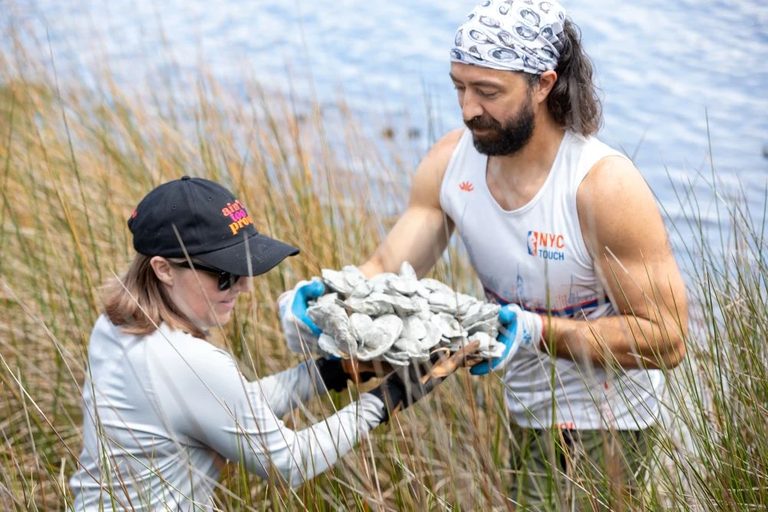
More than 30 volunteers labored to plant oyster shell habitats in the low tide shoals in Jacksonville’s Trout River at Riverview Park. The goal is to lure more oysters to grow there, to filter water and to stabilize the shore.
Oyster Habitats and Water Filtration
The planted habitats are known as Pervious Oyster Shell Habitats, or POSH for short. With help from the St. Johns Riverkeeper, Jax Oyster Conservation and other groups, 84 of the 30-pound circles of recycled oyster shells and cement were carried into the water to create habitat for oysters.
Supported by a grant to Local Initiative Support Corp. Jacksonville, or LISC, the POSHs will create the largest artificial oyster reef in the St. Johns River watershed. It significantly expands an oyster reef that included 40 POSH modules added last year in the Northside St. Johns River tributary.
“Oyster larvae like to attach themselves to some kind of substrate, and they love attaching to oyster shells,” said Jimmy Orth, executive director of St. Johns Riverkeeper. “What oysters can do is amazing. An adult oyster can filter up to 50 gallons of water.
The oyster habitats are important for another reason, said Marshiray Wellington, chairperson of the Riverview Collective Community Organization, which leads neighborhood revitalization and river policy in the predominantly Black Northside community. “We are helping to filter one of our most valuable resources, which is the Trout River,” Wellington said.
Community Involvement and Future Plans
By next year, they hope to add more POSH modules to eventually have 240 in the waterway, Hunter Mathews from Jax Oyster Conservation said. The goal is to provide some sort of water filtration, reducing some of the nutrients and pollution in the waterway, and stabilize the shoreline and protect the saltmarsh grass.
There was proof that the modules are becoming oyster nurseries, as Wellington showed volunteers the tiny mollusks growing on one planted last year. Then, she told volunteers that much more will be coming to the 11-acre park at 9620 E. Water St. near Lem Turner Road, including an expansion of the waterfront marsh to naturally handle flooding, a new boardwalk and modifying an old detention pond nearby to filter rainwater.
Original reporting: Jacksonville Today — read the source article.