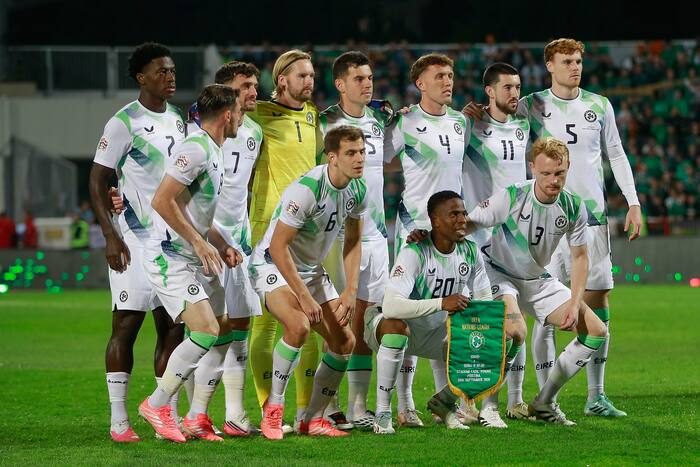
Journalists in Debrecen, Hungary – the venue for Israel’s “home” Nations League match on Sunday – were left waiting Saturday after the Ireland team’s press conference was pushed back to after a delayed training session. The conference was postponed only 15 minutes before its scheduled start.
Training postponed, players unsettled
Irish broadcaster RTÉ reported that the team’s training did not begin as planned and that players were still in their hotel more than two hours after the scheduled start time. RTÉ also noted that a number of squad members have expressed a desire not to play the upcoming games.
“And if they stay to their stated ambition that they have to be all in it together, if one or more want to be out, maybe they will all be out,” reporter Tony O’Donoghue told RTÉ Radio 1.
Growing calls for a boycott
In Ireland, public sentiment strongly favors the Palestinian cause, and pressure to boycott the two fixtures – the first in Debrecen on Sunday and the second, Ireland’s “home” match in Backa Topola, Serbia on Oct. 4 – has intensified. Midfielder Jason Knight, speaking after a recent 1‑0 loss in Kosovo, said the players are in a difficult position and questioned whether the matches should proceed.
Coach Heimir Hallgrimsson previously warned, “we’re not playing with genocide, we’re playing against genocide. We’re playing against Israel, we’re not playing with Israel,” a comment that drew a sharp rebuke from the Israeli soccer federation, which accused the Icelandic coach of “stupidity, ignorance and hypocrisy.”
FAI’s stance and public reaction
The Football Association of Ireland (FAI) has resisted calls to cancel the fixtures, warning that a boycott could trigger punitive sanctions from UEFA. Ireland is slated to co‑host the 2028 European Championship with England, Wales and Scotland, adding further complexity to the decision.
More than 160 Irish athletes signed an open letter urging the FAI to reconsider its position. Protesters gathered outside the team’s hotel in Dublin last week, and the SIPTU trade union displayed a large poster along the River Liffey urging players to “Go with your conscience!” and “Don’t play with genocide,” accompanied by an image of a blood‑splattered soccer ball.
Former Ireland manager Brian Kerr criticized the FAI, saying it has “lost the respect of the Irish people” by proceeding with the games. He recalled that the FAI had previously asked UEFA in November to remove Israel from the tournament on principle, only to reverse that stance.
Potential implications
If the boycott gains momentum, the FAI could face disciplinary action from UEFA, which may affect Ireland’s ability to host future international events. Conversely, yielding to pressure could set a precedent for political interference in sport, a concern for many who believe athletics should remain separate from geopolitical disputes.
For now, the situation remains fluid. The Ireland squad’s next steps will likely be shaped by ongoing dialogue between players, officials, and the broader public, as the nation watches closely how its beloved team navigates this contentious issue.
Original reporting: KSAT Sports (San Antonio) — read the source article.