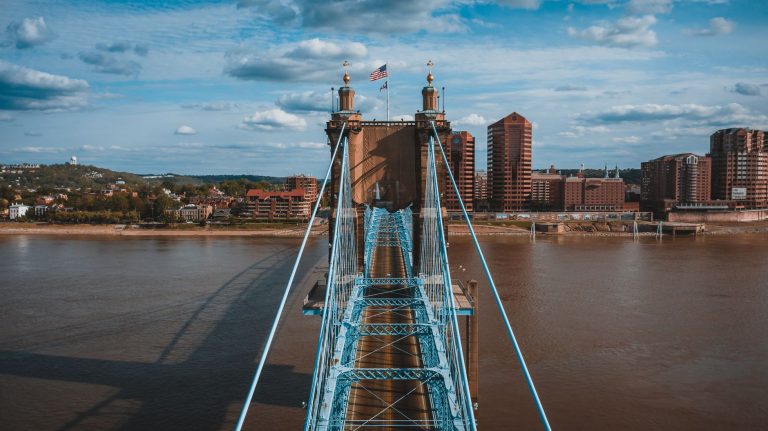
People who live in Covington will tell you: most visitors get off the Purple People Bridge, walk to Braxton, and leave. They never cross into Devou Park, which sits up on the hill above everything, watching Cincinnati across the river like a patient older relative who has seen a few things.
Devou isn’t a secret — it has its own Wikipedia page and a disc golf course that locals treat with the seriousness of a sacred rite — but it doesn’t get the same word-of-mouth as Eden Park or Smale Riverfront, and that gap is hard to explain once you’ve stood at the main overlook at dusk. The skyline sits there in full, unobstructed, no fence in the way, no admission gate. The Ohio bends just right. On summer evenings, Covington residents pull lawn chairs up to the low stone wall and just watch the light change on the buildings across the water. Nobody’s trying to monetize the view. It’s just there.
The park covers 550 acres — more than most people expect from a municipal park wedged into a Kentucky hillside — and it sprawls in several directions at once. There’s a band shell that hosts free concerts through the warm months, a small fishing lake, tennis courts, and a Bandstand that’s been standing since the early twentieth century. The Devou Park Golf Course is a short nine-hole public course where a round will run somewhere around fifteen dollars and the pace of play is blessedly relaxed. The disc golf layout cuts through wooded terrain and feels more technical than it looks on the map.
For families with young children, the park keeps a small but respectable zoo — Drees Pavilion Zoo, technically — that operates on a donation model and holds a modest collection of goats, rabbits, a few peacocks, and some waterfowl. It’s not the Cincinnati Zoo. It is not trying to be. Children seem to find it thrilling regardless.
The Licking River Greenway, a paved trail that connects the park to the lower neighborhoods of Covington, gives the whole area a connective tissue that rewards return visits on foot or by bike. The trail passes through a different Cincinnati — not the one on the postcards — where the river is narrow and quiet and herons stand in the shallows with the indifference of professionals.
Café Brauer, the park’s event venue, operates out of a restored 1909 building with a porch that faces the overlook. Rental events keep it busy on weekends, but the porch and the grounds are open to anyone who wanders up. The architecture alone — white clapboard, green trim, that particular early-century civic optimism — makes it worth the walk from the parking lot near the main shelter.
Parking is free throughout. The park stays open until eleven at night. On weekday mornings, it belongs almost entirely to dog walkers and runners who know which loop hits the best view of the city at mile two. By late afternoon, the overlook gathers a different crowd — people who drove over from Cincinnati proper, couples, photographers, the occasional person who appears to have discovered the park for the first time and can’t quite believe it was this close all along.
That reaction, repeated enough times, is its own kind of endorsement.