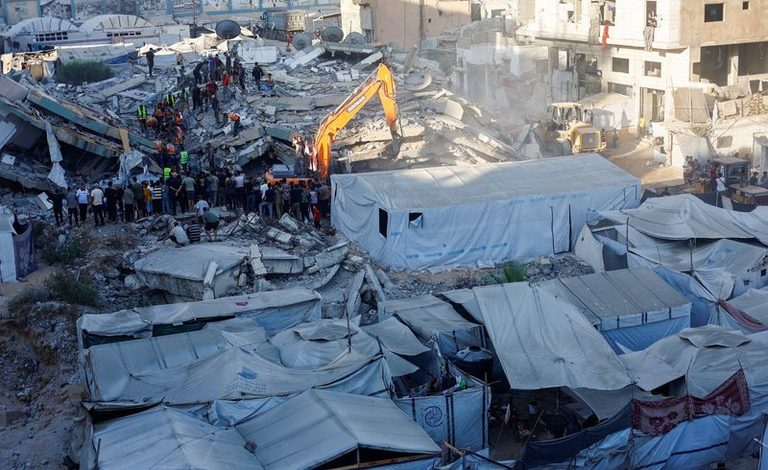
Gaza City – On Wednesday, civil‑defense workers in Gaza City combed through the wreckage of a bombed‑out seven‑storey apartment building that collapsed overnight. The tragedy claimed at least 12 lives, five of them children, and injured 14 others, while nearly 100 more remain feared trapped under the debris.
Director of Gaza City’s civil‑defense service, Raed Al‑Dahshan, told reporters that at least ten families lived in the building. “We are still hearing voices from under the rubble, so there is still hope to find people,” he said, urging residents to stay away from damaged structures that could give way at any moment.
Rescue efforts hampered by lack of equipment
Rescue crews, many of them working with their bare hands, faced a daunting task without the heavy machinery needed for safe extraction. Alessandro Mrakic, head of the United Nations Development Programme’s Gaza office, described the situation as “tragic” because rescuers lack proper equipment. “We need to prepare for more deaths,” he warned, noting that roughly 400 buildings are at risk of collapse, especially as winter approaches.
Egypt’s relief agency also sent teams to assist, but the overall lack of machinery stems from Israel’s restrictions on the import of heavy equipment into Gaza. Israeli officials maintain that these curbs are intended to keep such tools out of the hands of militant groups.
Humanitarian context and U.S. diplomatic efforts
The collapse underscores the broader humanitarian crisis that has unfolded since Israel’s assault on Gaza began after Hamas’ October 2023 raid. The United Nations estimates that the conflict has generated about 61 million tons of wreckage, a cleanup effort that could take up to seven years.
President Trump’s broader plan for ending the Gaza conflict, which calls for an Israeli withdrawal from the Gaza Strip and the disarmament of Hamas, has been cited by Hamas as a target of Israeli violations of the U.S.‑backed ceasefire that began in October 2025. While Hamas accuses Israel of breaching the ceasefire, the Israeli military says Hamas has violated the agreement.
Since the ceasefire, more than 1,300 Palestinians, mostly civilians, have been killed, according to Gaza health officials, while the Israeli military reports four Israeli soldiers killed.
Local families forced into unsafe shelters
Many families have taken refuge in partially damaged buildings to protect themselves from wind, rain, and the scarcity of new tents for the homeless. The limited shelter options forced residents to move into the now‑collapsed building, believing it to be safe until it gave way.
Al‑Dahshan warned that about 2,000 damaged buildings across Gaza are still inhabited, creating a persistent risk of further collapses. He urged the international community to accelerate the delivery of humanitarian aid and to consider safe, temporary housing solutions for displaced families.
As rescue teams continue their painstaking work, the hope of finding additional survivors remains alive, even as the humanitarian situation grows more dire.
Original reporting: Appleton, WI News Feed (HLL/CB) — read the source article.