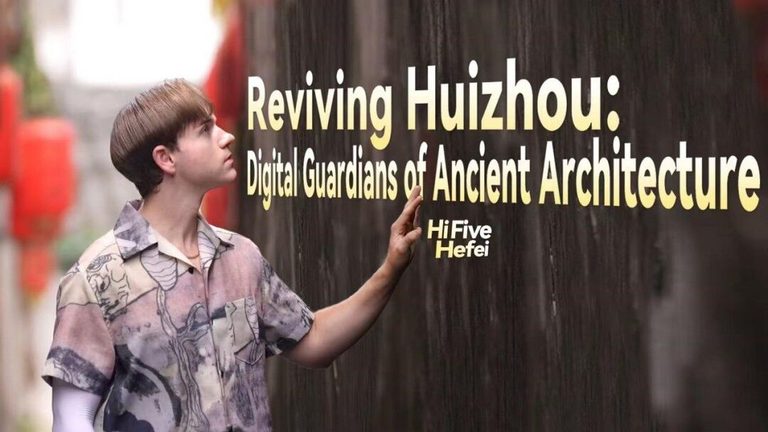
In the remote village of Xucun, nestled in Huizhou, Anhui Province, a team of students and researchers from Hefei University of Technology (HFUT) is turning heritage preservation into a high‑tech endeavor. Led by Professor Chen Gang, the group employs handheld 3D laser scanners to capture every joint and beam of a centuries‑old residence, producing a comprehensive point‑cloud model that can be examined on a computer screen.
Digital X‑ray of Historic Buildings
“I thought the answers were buried in history books,” said American participant Gavin Cooley as he watched the scanners sweep across intricate wooden beams. “But here, I’m hearing echoes of the future.” The technology provides an “X‑ray” of the structure, recording minute details that traditional surveys often miss. Associate Professor Chen Xin added that while the wisdom of ancient builders is deeply respected, modern tools give researchers the foresight to protect these cultural treasures.
From Data to Structural Insight
After scanning, postdoctoral researcher Wang Hanqin runs mechanical analyses on the data to assess structural safety. The digital archive serves as a baseline for evaluating deformation caused by centuries of wind, rain, and seismic activity. Doctoral candidate Zhang Yueting noted that the harsh mountainous environment forced historic locals to maximize every inch of land and stone, a creativity now echoed in the innovative preservation methods.
Heritage Meets Modern Use
The digital models are more than static records. HFUT students are compiling a full‑coverage database of Huizhou’s architectural “genes,” enabling adaptive reuse of ancient buildings. Some structures are already being integrated into modern cafés and boutique guesthouses, giving them new life while retaining their historic character.
A New Generation Carries the Torch
Hundreds of years ago, young men from Huizhou set sail down the Xin’an River to seek fortunes elsewhere. Today, a new generation of HFUT students returns to their villages armed with cutting‑edge technology, creating a poignant loop of departure and return. Their work showcases China’s innovative approach to cultural heritage protection on a global stage, offering a hopeful answer to the race against time that threatens world heritage sites from the Colosseum to the Pyramids.
Community and Cross‑Cultural Collaboration
The project also highlights how youth from different cultural backgrounds can find common ground through shared passion. As Cooley and the Chinese students discuss mortise‑and‑tenon joints and marvel at the digital models, cultural differences transform into a uniquely attractive collaboration, reinforcing the timeless value of heritage when paired with modern ingenuity.
Original reporting: KTBS 3 (Shreveport) — read the source article.