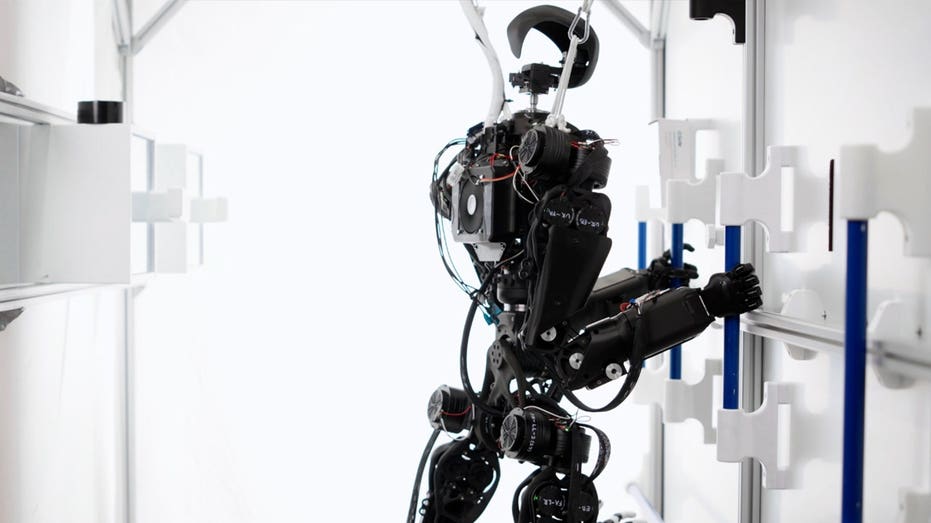
In a groundbreaking development, Orbit Robotics, an academic spinout from ETH Zurich, has introduced Helios, a four-armed robot designed to assist astronauts in space. This innovative robot is built to navigate the unique challenges of microgravity by using two pairs of arms—one pair to anchor itself and the other to handle tools and equipment.
Revolutionizing Space Operations
Helios’ design addresses the need for stability and functionality in orbit, where traditional legs are less useful. By employing a tendon-driven system, Helios reduces weight at the ends of its limbs, enhancing control and safety when maneuvering near delicate equipment. Its rolling-contact elbow joint ensures smooth movements, minimizing the risk of destabilizing the robot or sending objects adrift.
Previously, the team developed IKARUS, a platform that tested teleoperation and dual-arm manipulation, providing valuable insights for Helios’ design. The robot’s primary role will be to manage routine tasks inside spacecraft, such as unloading cargo and performing maintenance, which currently consume a significant portion of astronauts’ time.
Aiding Astronauts, Not Replacing Them
Orbit Robotics emphasizes that Helios is intended to support, not replace, astronauts. With astronauts spending an estimated 35% of their time on maintenance tasks, Helios could significantly reduce these demands, allowing astronauts to focus on scientific research and experiments that benefit from microgravity, such as studies on aging and cancer treatments.
As commercial space stations become more prevalent, the need for robots like Helios will grow. These robots could play crucial roles in satellite servicing and in-space construction, further expanding their utility beyond routine tasks.
While human spaceflight remains vital, robots like Helios offer a way to mitigate the physical risks astronauts face, such as radiation exposure and bone loss. By handling more of the repetitive and hazardous tasks, robots can enable astronauts to concentrate on work requiring human judgment and creativity.
Helios exemplifies the shift towards designing robots for specific environments, a trend that could influence various industries on Earth. As space exploration evolves, the balance between human and robotic roles will continue to adapt, potentially leading to safer and more efficient missions.
Original reporting: Fox News (HLL/CB) — read the source article.