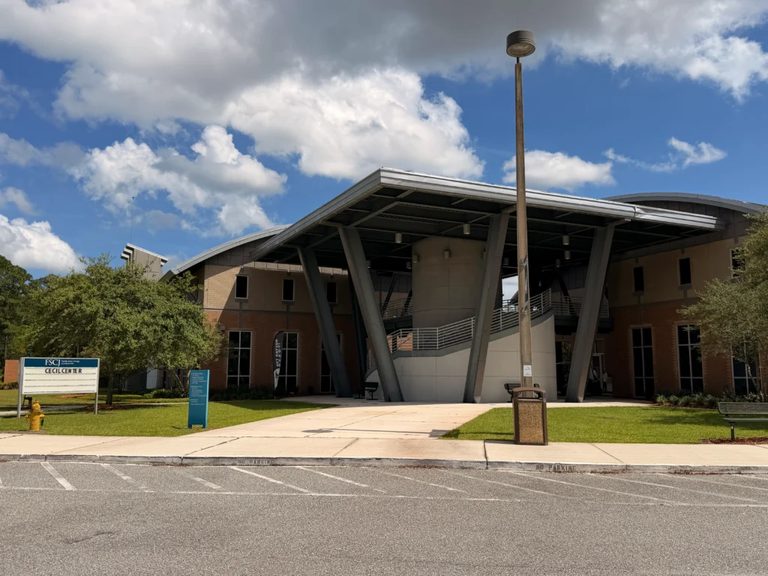
Governor Ron DeSantis used a news conference at Florida State College at Jacksonville’s (FSCJ) Cecil Center campus on Monday to unveil nearly $23 million in state grants aimed at expanding skilled‑trade and aerospace training in Jacksonville. The awards include $7 million from the Florida Job Growth Grant Fund for FSCJ’s new Cecil Training Institute and $5 million from the Florida Department of Transportation’s Spaceport Improvement Program for a large rocket‑motor test stand at Cecil Spaceport.
Expanding the skilled‑trade pipeline
FSCJ President John Avendano said the $7 million will accelerate the relocation of the college’s welding, heating, ventilation and air‑conditioning (HVAC) programs from the downtown campus to a purpose‑built facility near the Cecil Commerce Center. The move will double enrollment capacity, allowing the college to train up to 1,000 workers annually and serve an additional 1,250 high‑school students interested in these trades.
Avendano noted that the downtown campus has reached its maximum capacity for welding and HVAC instruction. By situating the institute next to Cecil Commerce Center, the college can better serve Florida’s maritime shipbuilding and repair sector, logistics firms, and emerging aerospace companies that have clustered in the area.
Supporting maritime and aerospace growth
The grant package reflects DeSantis’s focus on job growth tied to Florida’s maritime and defense industries. He emphasized that expanding training, infrastructure, and spaceport development not only fuels the state’s economy but also strengthens national security and cultural pride.
In recent years, aerospace firms such as Boeing, Otto Aerospace, and Hermeus have expanded operations near Cecil. The new rocket‑motor test stand, funded by the $5 million spaceport grant, is intended to attract additional commercial‑space companies and solidify Jacksonville’s reputation as a hub for space‑related manufacturing.
Local partnership and funding
Last year, the city of Jacksonville contributed $5 million toward purchasing a former charter‑school building near the Cecil campus, providing the initial home for the training institute. City Council member Raual Arias, who sponsored the municipal legislation, said the local match helped persuade state officials to fund the larger project.
City Council President Nick Howland and state Rep. Wyman Duggan also backed legislation requiring the Jacksonville Aviation Authority to develop an economic‑development plan for Cecil that includes the spaceport. Howland secured a $10 million allocation in the airport authority’s budget for a future expansion of FSCJ’s aviation‑mechanics program.
Looking ahead
Avendano indicated that a portion of the $7 million could be used to bolster the aviation‑mechanics program, which is currently at capacity with a waiting list extending into fall 2027. While the exact amount has not been set, the additional funding underscores the state’s commitment to building a skilled workforce that can meet the needs of Florida’s defense industrial base, which employs more than 900,000 Floridians.
Rep. Duggan, who serves as Florida House speaker until his term ends in November, described Cecil as the state’s “next Silicon Valley for commercial space,” highlighting the strategic importance of the investment.
Community impact
Local businesses and trade unions have welcomed the grants, noting that the skilled‑trade pipeline will help fill a growing labor shortage as many experienced workers retire. The expanded training facilities are expected to create new apprenticeship opportunities and strengthen partnerships between FSCJ, local manufacturers, and the military installations that rely on a steady supply of qualified technicians.
For Jacksonville residents, the initiative promises more accessible vocational education, higher‑pay job prospects, and a stronger regional economy anchored in both traditional maritime industries and cutting‑edge aerospace development.
Original reporting: Jacksonville Today — read the source article.