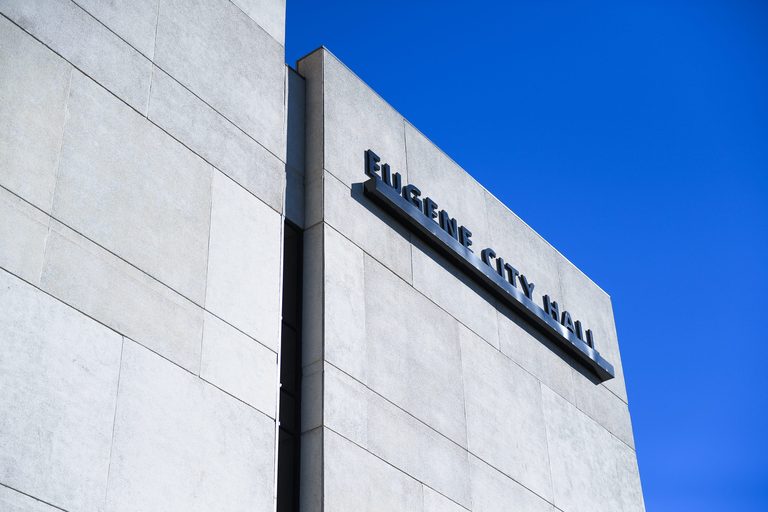
Planning and Development Director Alissa Hunter notified attorney Bill Kloos on Sept. 8 that a data‑center cannot be operated at the former Hynix semiconductor plant located at 1830 Willow Creek Circle in west Eugene. The city’s decision was based on the property’s existing E‑1 zoning, which is intended for firms that provide large numbers of jobs and help achieve economic diversification objectives.
Why the data‑center does not qualify
Kloos had asked in July whether a range of industrial uses—including a data‑center, manufacturing, or research and development—could be permitted on the 1.2‑million‑square‑foot, 200‑acre site. While the request covered many possibilities, the city’s response focused solely on the data‑center request.
Hunter explained that the “Information Technology Services” land‑use category, added to the Eugene code in 2001, was never meant to cover modern, large‑scale data‑centers. “Back in 2001, the City Council could not have intended the ‘Information Technology Services’ use to encompass the large modern data centers described in the zone verification application,” she wrote.
When the council revised zoning rules in 2014 and created the E‑1 category, it did not add data‑centers as an allowed use, even though cloud computing was already widely available and modern data‑centers were being built elsewhere in Oregon.
Economic diversification and employment standards
The E‑1 zone is designed for firms that bring many employees per acre and foster economic diversification. By contrast, the proposed data‑center would be “almost self‑operating, with little human presence or interaction on site,” Hunter noted. The city expects E‑1 users to have a campus‑like setting with a substantial workforce, not a facility that runs largely on automated systems.
City code also requires E‑1 users to avoid generating offensive external impacts such as excessive noise, pollution, or vibration. Hunter pointed out that data‑centers are “notoriously” associated with diesel generators that produce noise and exhaust, as well as water‑use issues that can raise temperature, sediment, nitrates, and poly‑fluoroalkyl substances—commonly called “forever chemicals.”
Size, traffic and parking considerations
The application did not specify whether the data‑center would occupy the entire campus, require new buildings, or use a combination of existing structures. Because of this uncertainty, the city could not determine whether the project would meet the building‑size criteria for E‑1 zoning.
Regarding traffic, Kloos indicated the data‑center would generate only “limited routine visitor activity,” unlike retail or customer‑facing uses. Hunter responded that the city evaluates traffic generation to ensure impacts are less intense than intended for the zone. She argued that a land‑use that occupies a large parcel of employment land but produces “extremely little” employee traffic is equally relevant to the zoning analysis.
Next steps
Hunter concluded that, for all the reasons outlined, the data‑center use described in the verification request is prohibited in the E‑1 zone. The city’s decision can be appealed to the Oregon Land Use Board of Appeals.
The former Hynix plant, once the region’s largest semiconductor factory, closed in 2008 after laying off 1,400 workers. It has changed hands several times, most recently sold in 2020 to Stratacache, an Ohio‑based digital‑sign company whose operations on the site have been dormant. Kloos said his client has the campus “under contract” and wishes to purchase the property, but the city’s zoning rules currently block a data‑center development.
Both Kloos and a city spokesperson did not immediately return requests for comment.
Original reporting: Homepage – Lookout Eugene-Springfield — read the source article.