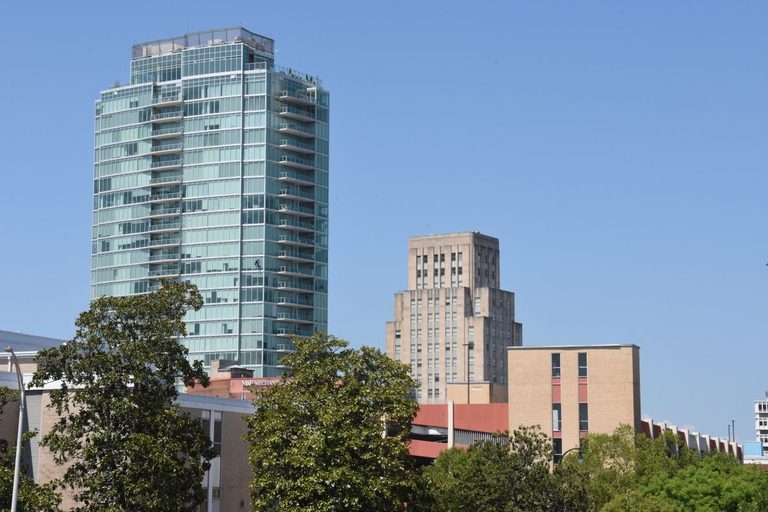
Durham City Council members will meet Thursday at 1:00 p.m. to hear the final Vision Plan for the downtown freeway that has divided the city since the 1970s. The plan, developed after years of community outreach, presents three distinct options for how the corridor might evolve.
Background and community impact
The elevated freeway was built to link Research Triangle Park with central Durham, but its construction cut through historic Black neighborhoods, including portions of the Hayti community. Residents and local churches still hear the traffic roar; St. Mark AME Zion Church, a congregation that predates the highway, serves as a reminder of the road’s legacy.
Option 1 – Boulevard conversion
This proposal would remove the elevated structure and replace it with an at‑grade urban boulevard. The plan calls for a restored street grid, new intersections, wide sidewalks, dedicated transit lanes and opportunities for new housing. Planners say the design aligns most closely with community‑expressed goals. Estimated cost: $500 million.
Option 2 – Freeway cap (land bridge)
Under the cap option, structural “lids” would be built over the existing freeway, creating parks and plazas that reconnect the neighborhoods while preserving traffic flow below. The concept mirrors projects in Dallas, TX and Denver, CO. Mayor Williams identified this as his preferred choice, noting the potential to create “real estate out of the air.” Cost estimates range from $450 million to $800 million over the next ten to twenty years.
Option 3 – Freeway modernization
The third alternative focuses on targeted upgrades: reducing the freeway’s downtown footprint, adding auxiliary lanes and improving traffic flow. Community feedback suggests many feel this does not go far enough to heal the historic division. Projected cost is about $450 million.
Funding and next steps
Mayor Williams warned that Durham’s tax base cannot shoulder the expense alone. He emphasized the need for state and federal partnerships, noting that the freeway is owned and maintained by NCDOT. The city will move forward with environmental review, establish a governance structure for collaboration, begin preliminary engineering and pursue a multi‑source funding strategy.
Community voices
Pastor Julian Pridgen of St. Mark AME Zion Church reflected on the road’s impact, saying, “People are resilient, we move on, but we don’t always forget, which is a good thing.” He expressed hope that any redesign would better knit the community together.
The council’s work session will provide a forum for residents to ask questions and offer input before the city proceeds with detailed studies.
Original reporting: WRAL Raleigh — read the source article.