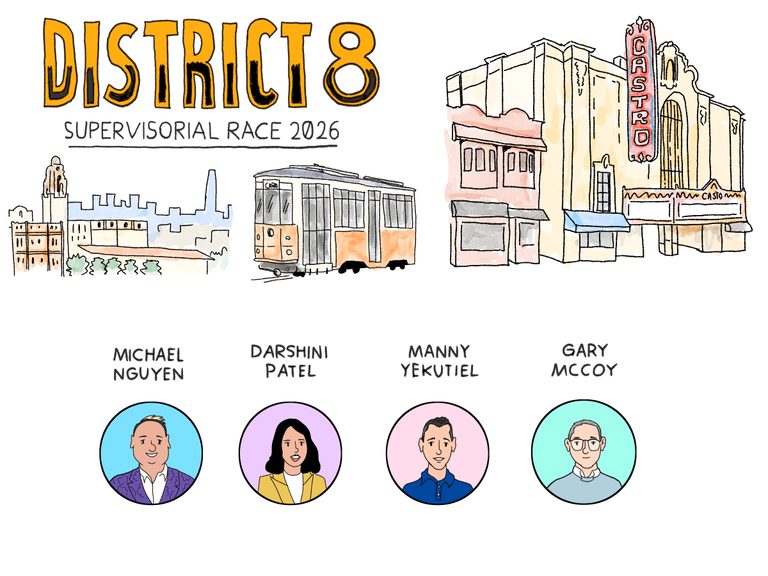
San Francisco’s District 8, home to the Castro, Noe Valley, Glen Park and other iconic neighborhoods, is at the center of a citywide effort to make cycling safer. The San Francisco Municipal Transportation Agency’s 2025 “Biking and Rolling Plan” promises a bike lane within a quarter‑mile of every resident over the next decade or so. With limited street space, the plan often calls for taking away driving lanes or parking spaces, a point of contention for many residents and local merchants.
Candidate positions
Manny Yekutiel – Founder of Manny’s and co‑founder of the Civic Joy Fund – says District 8 needs a connected network of protected bike lanes and “slow streets” that let people travel safely and joyously. He calls for repaving Upper Market, improving the Wiggle at Sanchez and Steiner, and adopting the Safe School Zones within the Biking and Rolling Plan. Yekutiel would support removing parking where it is essential to make routes genuinely safe, but only after working closely with neighbors and small businesses to design thoughtful changes.
Gary McCoy – Former staffer to former Speaker Nancy Pelosi and former vice president of policy at HealthRIGHT 360 – backs extending the protected 17th Street bike lane to Jane Warner Plaza in the Castro, even though the proposal removes parking. He stresses the need to deliver District 8’s portion of the Biking and Rolling Plan quickly so cyclists are not forced onto fast, dangerous traffic. McCoy emphasizes early involvement of neighbors, the disability community, and local merchants to balance parking needs responsibly.
Michael Nguyen – Patent attorney – answers “yes” to supporting bike‑lane projects. His top priority is 17th Street between the Castro and Valencia, and he would make Wiggle Plaza permanent with Sanchez and Steiner designated as slow streets. Nguyen says he seeks a real balance between parking and protected lanes, but when a choice must be made, he chooses people over cars, noting that District 8 has lost too many neighbors to traffic violence.
Darshini Patel – Former DoorDash employee and political campaign staffer – focuses on high‑injury streets such as Church, 17th, and Dolores. She proposes protected lanes with physical barriers and would make the Street Safety Act binding so that safety upgrades are included with repaving. Patel would sequence parking removals to preserve accessible spaces and commercial loading, starting where realistic alternatives exist. She points to Hoboken’s decade‑long record of zero traffic deaths as a model for San Francisco.
Common themes
All four candidates agree that protected bike lanes are essential for safety and that the city must find ways to accommodate cyclists without sacrificing community access. Each stresses the importance of engaging local merchants, residents and advocacy groups early in the planning process. While the candidates differ on specific routes and the extent of parking removal, they share a commitment to making the district’s streets safer for families, seniors and commuters alike.
Election context
The District 8 supervisor race will be decided on November 3, 2026. Voters can learn more about each candidate’s platform and endorsements through the Mission Local “Meet the Candidates” series. The race highlights a broader city debate over how to balance limited curb space, parking availability and the growing demand for safe, protected cycling infrastructure.
San Francisco’s ongoing “Biking and Rolling Plan” reflects a national trend toward expanding active‑transport options, but the local debate underscores the need for solutions that respect both mobility and the traditional family‑oriented neighborhoods that define District 8.
Original reporting: Mission Local — read the source article.