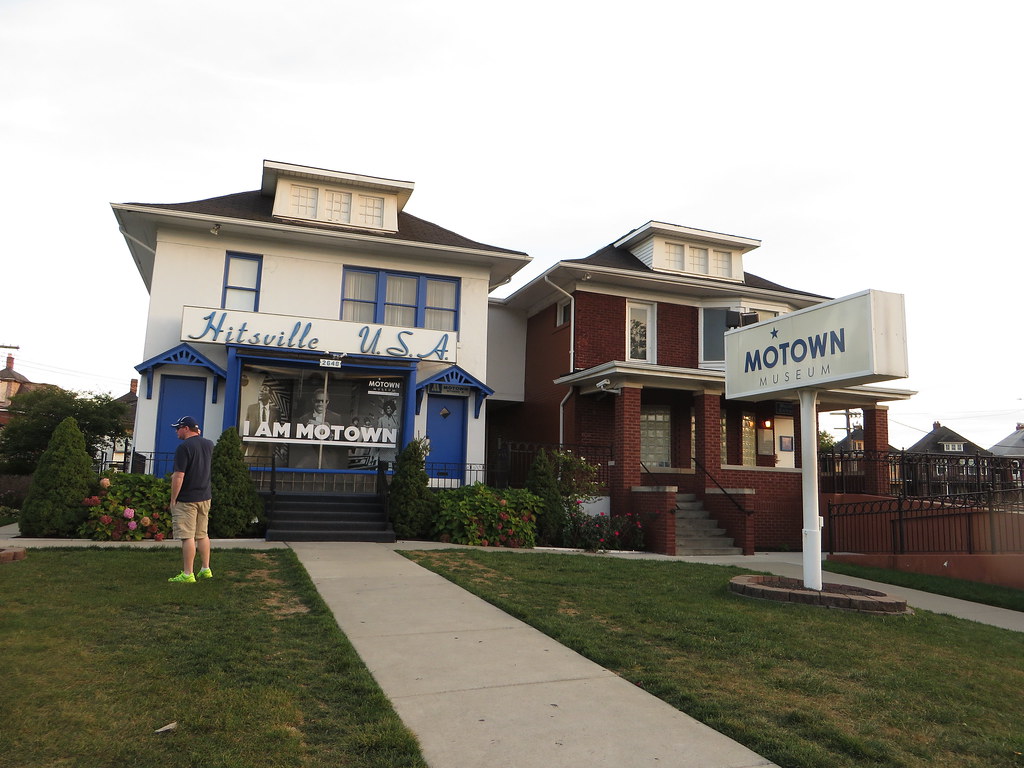
There are places you visit, and then there are places that reach into your chest and rearrange something. The Motown Museum on West Grand Boulevard is firmly the second kind. The moment you step through the door of that iconic blue-and-white house — the one with the hand-painted “Hitsville U.S.A.” sign hanging above the entrance — you understand immediately why people fly in from Tokyo, London, and São Paulo just to stand exactly where you’re standing right now.
Located in the New Center neighborhood, just a few miles north of downtown Detroit, the museum occupies the original two-story house that Berry Gordy Jr. purchased in 1959 for $800. That modest investment launched one of the most consequential record labels in American history. Marvin Gaye, Diana Ross and the Supremes, Stevie Wonder, Smokey Robinson, the Jackson 5 — they all recorded here. They all walked these floors. And when you take the guided tour, you feel that history pressing up against you from every direction.
The tour runs roughly 45 minutes to an hour, and your guide brings genuine enthusiasm to every room. You’ll see the cramped but perfectly preserved living quarters where early Motown artists actually lived while they worked, the original office furniture, gold and platinum records lining the walls, sequined gowns behind glass, and personal photographs that feel almost too intimate to look at. It is one part museum, one part time capsule, one part shrine.
But the room that stops everyone cold is Studio A — the basement recording space where the Motown Sound was born. The original equipment is still in place: the upright piano, the microphone boom stands, the baffling panels built from ceiling tiles and cardboard egg crates for acoustic dampening. Berry Gordy engineered hits here on a shoestring budget, and the room still hums with that creative ingenuity. Visitors are invited to stand at the microphone and, almost without fail, someone starts singing. Sometimes everyone joins in. It happens every single tour.
The museum recently completed a major expansion, adding a state-of-the-art gallery space that offers deeper dives into the social and cultural context of Motown — how this music intersected with the Civil Rights Movement, how it changed radio, how it reshaped what American pop could sound like. The new galleries are thoughtfully curated and give the whole experience a satisfying scope and weight.
Plan to arrive a few minutes early, especially on weekends, as tours fill up quickly. Tickets are reasonably priced, and the gift shop carries everything from vinyl reissues to tasteful keepsakes that won’t embarrass you on your shelf at home. The museum is easily accessible from the Lodge Freeway, and street parking is generally available nearby.
Detroit gave the world a sound that still plays in every corner of the globe. Coming here, to this unassuming house on West Grand Boulevard, is the closest you can get to touching the source of that gift. Do not miss it.